Blue Staffy: Colour, Genetics, Health and What to Know Before You Buy
Quick answer
A blue Staffy is a Staffordshire Bull Terrier with a slate blue-grey coat. It is a colour, not a separate breed or type, and blue is an accepted colour in the breed standard. The colour comes from a recessive dilution gene and, despite the sales talk, it is not rare. Blue Staffies are the same size and have the same temperament as any other Staffy. The one colour-linked health issue to know about is colour dilution alopecia, a coat and skin condition that affects some dilute dogs but not all of them.
Blue is the most searched-for Staffy colour, and the one with the most myths attached: rare, valuable, bigger, or doomed to skin problems. Most of that falls apart when you check it against breed standards and veterinary sources. Our full guide to Staffy colours covers every coat and pattern; this article goes deeper on blue alone.
I am not a vet or a geneticist, and my own Staffy, Guinness, is brindle, not blue. So this guide leans on breed standards, veterinary genetics labs and veterinary dermatology references, which are linked throughout and listed at the end.
This article contains affiliate links. If you buy through them, Staffy World may earn a small commission at no extra cost to you. See our affiliate disclosure.
What is a blue Staffy?
A blue Staffy is a Staffordshire Bull Terrier whose coat is an even slate blue-grey instead of black. It is not a separate breed, a type or a bloodline. It is one of the colours listed in the breed standard.
The Royal Kennel Club breed standard accepts white, red, fawn, black and blue, any of these with white, and any shade of brindle with or without white. The standard used in Australia has the same colour list, and so does the American Kennel Club standard. Black and tan and liver are the colours the standards rule out.
Nose and eye colour is where blue dogs differ. The dilution gene lightens nose leather as well as coat, so a blue Staffy has a dark blue-grey nose, not a true black one. The UK standard, updated in November 2025, allows for that: it asks for a nose that is “black or as dark as possible in blue dogs”. The older wording still published in Australia simply asks for a black nose. Both standards prefer dark eyes but accept that eye colour can relate to coat colour, which is why many blue Staffies have lighter eyes than a black or brindle dog.
For a pet, none of that matters. It matters in the show ring, and it is worth knowing if a seller describes a pale nose or very light eyes as a special feature.
Why are some Staffies blue? The dilution gene explained simply
Staffies are blue because they have inherited two copies of a recessive dilution gene, one from each parent. The gene does not add blue pigment. It changes how black pigment is spread through each hair, so a coat that would have been black looks grey-blue.
Geneticists call this the D locus, and the gene involved is MLPH (melanophilin). According to the UC Davis Veterinary Genetics Laboratory, dilution is recessive: a dog needs two copies of a dilute variant before the colour shows.
That gives three possible results for any Staffy:
This is why two black or brindle Staffies can produce a blue puppy if both are carriers. On average, one in four puppies from a carrier-to-carrier mating will be blue. Two blue parents will only ever have dilute puppies.
Blue, blue brindle, blue fawn, grey and silver: what is the difference?
Blue, blue brindle and blue fawn are all the same dilution gene acting on different base coats. Grey and silver are everyday or sales words for blue, not separate colours.
Here is how the common names compare:
|
Name |
What it looks like |
Real term or marketing? |
Notes |
|---|---|---|---|
|
Blue |
Solid slate blue-grey, often with a small white chest patch |
Real: named in the breed standard |
A black coat diluted by two copies of the dilution gene. |
|
Blue brindle |
Blue-grey stripes over a paler fawn base |
Real: covered by “any shade of brindle” |
A brindle dog with the dilution gene. The striping can be faint. |
|
Blue fawn |
Pale fawn coat with a grey cast and a blue-grey nose |
Descriptive breeder term, not a separate standard colour |
A fawn dog with the dilution gene. The nose colour is the giveaway. |
|
Grey or silver |
The same as blue, sometimes a lighter shade |
Everyday or marketing words |
Genetically the same as blue. |
|
Lilac or champagne |
Pale, pinkish grey-brown |
Mostly marketing in Staffies |
Lilac is dilution on a liver (brown) coat. Liver is ruled out by the breed standard, so lilac is too. Champagne has no fixed meaning. |
Are blue Staffies rare?
No. Blue Staffies were uncommon a few decades ago, but experienced breeders now widely describe blue as one of the most commonly bred colours in the breed, in the UK especially.
I could not find official colour-by-colour registration figures, so I will not put a number on it. A simple reality check is to browse puppy listings in your area and see how often blue comes up.
The genetics explain why. Because two blue parents produce all-blue litters, the colour is easy to breed for once there is demand. “Rare” in an ad is a sales word, not a description of the breed.
That does not make a blue puppy a poor choice, or the person selling it a poor breeder. It means rarity on its own is not a reason to choose one puppy over another. Health testing, temperament and how the puppies are raised are.
Are blue Staffies bigger, heavier or different in temperament?
No. Coat colour does not change a Staffy’s size, weight, temperament or lifespan, and I found no evidence that blue dogs differ from other colours on any of them.
The breed standard gives one set of measurements for every colour: 36 to 41cm at the shoulder, with males around 13 to 17kg and females 11 to 15.4kg. A blue Staffy that is much taller or heavier than that is not big because it is blue. It is more likely from a larger-framed line, overweight, or not a purebred Staffordshire Bull Terrier. Our Staffy weight chart shows healthy weights by age.
Temperament comes from breeding, socialisation and training, not pigment. If Guinness stood next to a well-bred blue Staffy of the same build, the only real difference would be the paintwork.
Blue Staffy health: what is colour dilution alopecia?
Blue Staffies are not unhealthy dogs, but there is one condition tied to their colour: colour dilution alopecia (CDA), a hereditary coat and skin condition seen in some dilute-coloured dogs.
In CDA, pigment clumps unevenly in the hair, which makes the hairs fragile. The Merck Veterinary Manual describes affected dogs as born with a normal coat, then developing thinning hair and inflamed skin in the blue or fawn areas, usually before their first birthday. Dry, scaly skin and bacterial skin infections can follow.
How common is it in blue Staffies? Nobody has published a reliable figure. The Staffy is not on the lists of most-affected breeds in the major veterinary references, but it does occur: a 2021 veterinary case report describes a blue Staffordshire Bull Terrier whose coat began thinning at six months of age. Many blue Staffies never develop it.
There is no DNA test that predicts it. Laboklin, a veterinary genetics laboratory, notes that genetic tests can show a dog is dilute but cannot tell you whether that dog will go on to develop CDA.
CDA cannot be cured, but veterinary sources describe it as manageable and largely cosmetic, with treatment aimed at dry skin and any secondary infections. Hair loss has plenty of other causes too, including allergies, mites and hormonal problems, so thinning patches or itchy skin are a reason to see your vet, not to diagnose it yourself. A firm diagnosis of CDA needs a skin biopsy. Our guides to Staffy skin problems and Staffy health problems cover the wider picture.
Do blue Staffy puppies change colour?
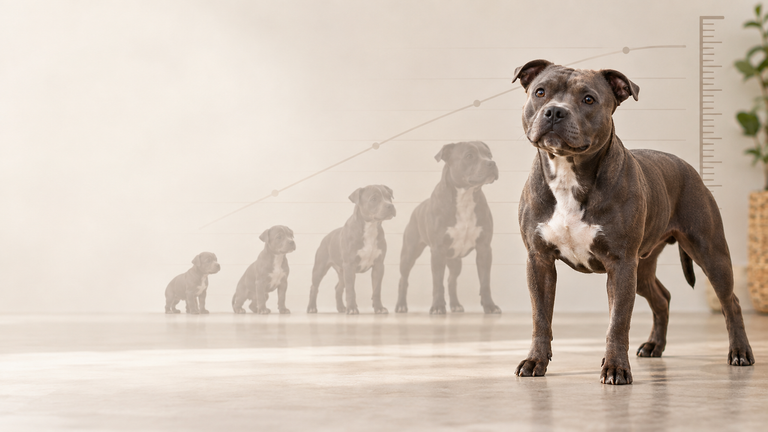
Not much. A dilute puppy is generally born blue and stays blue. It does not start black and fade to grey later.
What can shift is the shade. As the puppy coat gives way to the adult coat, a blue Staffy may look a little darker, lighter or more steel-toned, and blue brindle striping can become easier or harder to see. Most puppies’ eyes also start out bluish and darken over the first few months.
I could not find formal studies on this, so treat it as general guidance. The parents’ adult coats are the best preview of how a puppy will turn out.
Buying a blue Staffy: what should you ask a breeder?
Ask the same questions you would ask about any Staffy puppy, plus a few that are specific to the colour. Colour is best treated as the last thing you choose on, not the first.
Questions worth asking:
RSPCA Australia advises visiting where the puppies are raised, meeting both parents and expecting a full health history. It also suggests looking at adoption first. Staffies and Staffy crosses of every colour come through shelters and breed rescue groups, so it is worth checking those before you commit to a puppy.
Some breeders charge more for blue puppies. I have not found a reliable, dated source for typical prices, so I will not quote any. Whether a premium is worth paying is your call. It helps to be clear about what you are paying for: health testing and careful rearing add real cost to a litter, while the colour itself does not.
If you already have a blue Staffy, or you have adopted one with no paperwork, a breed-and-health dog DNA test can fill in some of the gaps. Look for a kit that reports the D locus (dilute) result along with the Staffy health markers L-2-HGA and hereditary cataracts, and that uses a simple cheek swab. It will not predict colour dilution alopecia, and it does not replace a breeder’s certificates for the parents or a vet’s diagnosis, but it does tell you what your own dog carries.
Staffy World pick
Dog DNA test kit
Chosen to match the advice above. Check the size and materials on the listing before you buy.
Blue Staffy vs blue nose pit bull vs blue Amstaff: are they the same?
No. They are three different breeds that happen to share the same dilution gene. “Blue nose pit bull” is an informal name for a blue American Pit Bull Terrier, and a blue Amstaff is a blue American Staffordshire Terrier.
The Amstaff is noticeably bigger, at around 43 to 48cm at the shoulder against 36 to 41cm for a Staffy. In Australia, “English Staffy” means the Staffordshire Bull Terrier, so a blue English Staffy is simply a blue Staffordshire Bull Terrier. If a dog sold as a blue Staffy stands well over 41cm, it may be an Amstaff or a cross. Our guide to the types of Staffy explains how to tell them apart.
How do you care for a blue Staffy’s coat?
Care for it like any other Staffy coat, with a little extra attention to the skin. The coat is short, smooth and close, so a weekly brush and an occasional bath are enough.
When you do bathe, a gentle, soap-free dog shampoo is a sensible choice for a short coat that can run dry. Look for a fragrance-free or lightly scented formula made for dogs, and rinse it out thoroughly. Bathe only when your dog is dirty or smelly, because over-bathing strips the skin’s natural oils. No shampoo prevents or treats colour dilution alopecia.
Staffy World pick
Gentle, soap-free dog shampoo
Chosen to match the advice above. Check the size and materials on the listing before you buy.
A short, single coat gives little protection from cold or strong sun. On frosty mornings a coat helps, and our Staffy clothing guide covers sizing and fit. In summer, stick to shade in the middle of the day.