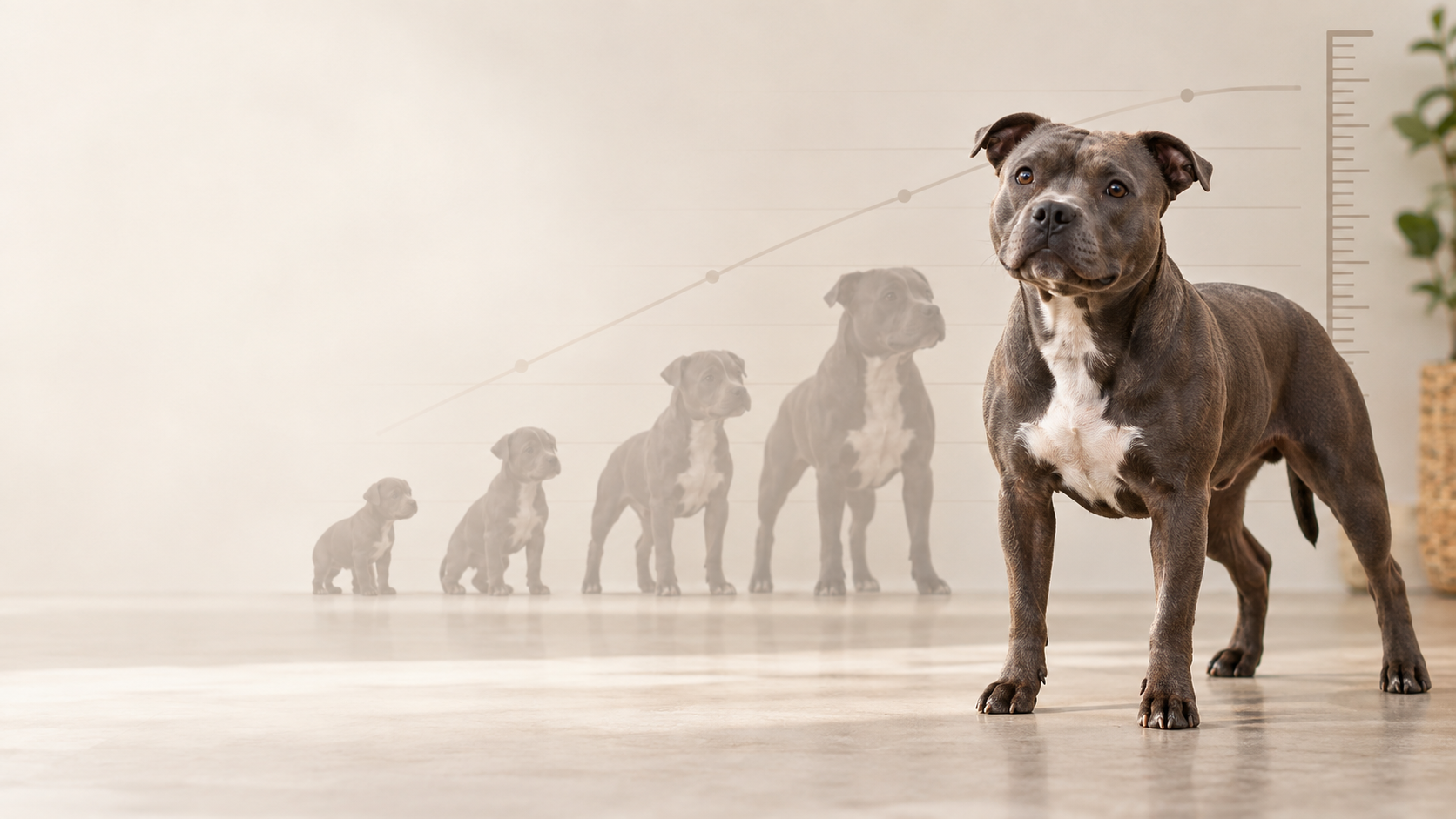
Staffy Weight Chart
Staffy Weight Chart: What to Expect at Every Age
An adult male Staffy typically weighs 13–17.25 kg (28–38 lb) and stands 36–41 cm (14–16 in) at the shoulder. Adult females are slightly smaller at 11–15.25 kg (24–33.5 lb) and 35.5–40.75 cm (14–16 in). Most Staffies reach their final height by around 12 months but keep filling out with muscle until 18–24 months.
Those numbers come from the official Kennel Club breed standard — not a guess, and not a competitor’s copy-pasted spreadsheet. Below is the full growth curve by age, in kg and lb, plus what actually happens to a Staffy’s body at each stage.
Adult Size at a Glance
|
Male (Dog) |
Female (Bitch) |
|
|---|---|---|
|
Weight |
13–17.25 kg (28–38 lb) |
11–15.25 kg (24–33.5 lb) |
|
Height at Withers |
36–41 cm (14–16 in) |
35.5–40.75 cm (14–16 in) |
Worth knowing: this is a breed standard — the ideal used for judging show dogs — not a hard rule for a healthy pet. The Kennel Club’s own guidance for prospective buyers says explicitly that a dog may be larger or smaller than the standard states. Plenty of much-loved, perfectly healthy companion Staffies sit outside this range, especially neutered dogs and dogs from working or “old-style” bloodlines, which tend to run a bit heavier and taller than the show standard. If your dog is outside these numbers but your vet is happy with their body condition, there’s nothing to worry about.
Staffy Growth Chart by Age
The table below estimates typical weight ranges from puppyhood to full maturity, based on the percentage of adult weight a Staffy has usually reached at each age. Individual dogs vary — genetics, sex, neutering age, and diet all play a part — so treat this as a guide, not a target.
|
Age |
Male weight (kg) |
Male weight (lb) |
Female weight (kg) |
Female weight (lb) |
|---|---|---|---|---|
|
8 weeks |
2–3.5 kg |
4–8 lb |
1.5–3 kg |
3.5–6.5 lb |
|
3 months |
3.5–5 kg |
7.5–11 lb |
3–4.5 kg |
6–10 lb |
|
4 months |
4.5–7 kg |
10–15 lb |
4–6 kg |
8.5–13 lb |
|
5 months |
6–8.5 kg |
13–19 lb |
5–7.5 kg |
11–16.5 lb |
|
6 months |
7–10.5 kg |
15.5–23.5 lb |
6–9.5 kg |
13–21 lb |
|
8 months |
9–13.5 kg |
20–29.5 lb |
7.5–12 kg |
17–26 lb |
|
10 months |
10.5–15.5 kg |
23–34 lb |
9–13.5 kg |
20–30 lb |
|
12 months |
11.5–16.5 kg |
25.5–36 lb |
10–14.5 kg |
22–32 lb |
|
18 months |
12.5–17.5 kg |
27.5–38 lb |
10.5–15.5 kg |
23.5–33.5 lb |
|
24 months (mature) |
13–17.25 kg |
28–38 lb |
11–15.25 kg |
24–33.5 lb |
What’s Actually Happening at Each Growth Stage
When Do Staffies Stop Growing?
Short answer: most Staffies reach their full height by around 12 months, but don’t finish filling out with muscle and bulk until 18–24 months. A small number of dogs, especially males, keep adding muscle mass to around 3 years old. If your Staffy is well past 2 years old and still visibly gaining weight, that’s worth mentioning to your vet — at that point it’s more likely to be condition (weight gain) than growth.
As your Staffy moves through these growth stages, their training needs shift to – our complete Staffy puppy training guide covers what to focus on at each stage.
What Affects How Big Your Staffy Gets?
A few things influence where in the range your dog will land:
Is My Staffy Under or Overweight?
Weight charts are a guide, not a diagnosis. The more reliable check is body condition, not the number on the scale:
If your Staffy’s tracking underweight or overweight, portion size is usually the first thing to check – see how full feeding chart by weight and age for exact daily amounts.
If you’re still unsure, ask your vet for a body condition score (BCS) check at your next visit — it takes thirty seconds and is far more accurate than comparing your dog to a chart.
We have a 14 year old staffy bitch that has gone really skinny
Hi Laura,
Thanks for sharing this, and I’m sorry to hear your girl has been losing weight. At 14, noticeable weight loss is worth taking seriously. The weight chart in this article is a guide for healthy adult Staffies, so it can’t tell you what’s going on with a senior dog.
I’d book her in for a vet check soon rather than waiting to see if she bounces back.
It will help your vet if you note down:
– Whether her appetite has changed, or she’s eating but still losing weight
– Whether she’s drinking or toileting more than usual
– Any bad breath, drooling or dropping food
– Any lumps, changes in energy, or stiffness getting up
If you can, weigh her at home or at the vet so you have a number to track.
I hope she’s feeling better soon.
Steve (and Guinness)