Staffy Health Problems and Lifespan
Staffy Health Problems and Lifespan: What Every Owner Should Know
Quick answer
Most Staffies live around 11 to 14 years. The largest UK vet-records study put their life expectancy at birth at about 11.3 years, slightly above the average for all dogs. The breed is generally robust, but the health problems to know about are two inherited conditions with DNA tests (L2HGA and hereditary cataract), skin allergies, lumps including mast cell tumours, seizures, and weight-related joint strain.
Staffies have a reputation as tough little dogs, and the research mostly backs that up: a large Royal Veterinary College study found no evidence that they have more health problems overall than other dogs. But there is a short list of conditions that turn up more often in Staffies, and knowing them helps you pick a good breeder, spot trouble early and get more out of your vet visits.
Below you’ll find lifespan, the inherited conditions to ask a breeder about, eyes, joints, skin, lumps, heat, weight and ageing. I’m a Staffy owner, not a vet, so take anything that worries you to your own vet for a proper diagnosis.
How long do Staffies live?
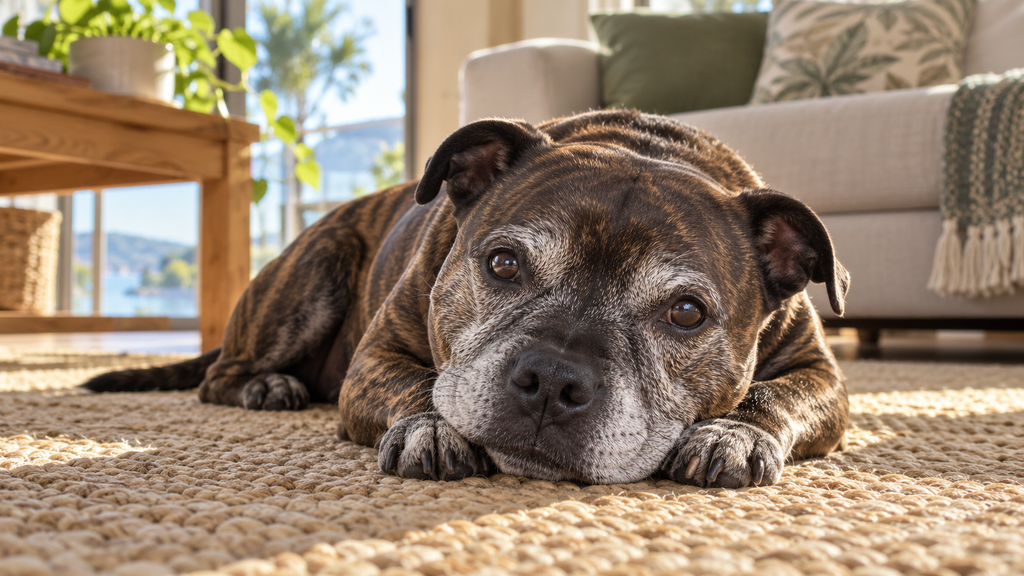
Most Staffies live somewhere between 11 and 14 years, and plenty reach their mid-teens. The best UK data comes from VetCompass at the Royal Veterinary College: a 2022 study that built life tables from 2,347 Staffordshire Bull Terriers that died under UK vet care between 2016 and 2020 estimated their life expectancy at birth at about 11.3 years, compared with 11.2 years for dogs overall.
That figure is an average from birth, so it includes dogs lost young to accidents or illness. A Staffy that makes it through its first few years healthy can reasonably expect more. An earlier VetCompass study (2013) recorded a median age at death of 10.7 years for Staffies, and the UK Kennel Club lists the breed’s lifespan as “over 12 years”.
What tends to shorten or extend a Staffy’s life:
Are Staffies a healthy breed?
Yes, broadly. In the 2020 VetCompass study of 1,304 Staffies under UK vet care, three-quarters of the most common conditions showed no difference in risk compared with other dogs, and the researchers found “no evidence that SBTs have higher overall health problems than non-SBTs”.
The same study found Staffies were more likely than other dogs to be diagnosed with seizures (about 2.1 times the odds), atopic dermatitis (1.9 times), skin lumps (1.8 times) and stiffness (1.8 times). On the plus side, they were less likely to have dental disease, heart murmurs, anal sac impaction and, notably, kneecap problems (patellar luxation). Swedish pet insurance data (Agria, 2011 to 2016) tells a similar story: insured Staffies needed vet care a little more often than the all-breed average, mostly for skin and joint issues, but their recorded mortality risk was lower than average.
One welfare point worth knowing: the Staffordshire Bull Terrier breed standard calls for a moderate muzzle, not a squashed one. Dogs bred with exaggerated short faces, very heavy frames or as “mini” or “pocket” Staffies move away from the standard, and that’s where breathing and joint problems creep in. Our guide to the different types of Staffy explains why.
Common Staffy health problems at a glance
Here are the conditions that come up most often in Staffy research and breed-club health guidance, and what to ask your vet about each:
|
Condition |
Type |
Typical signs |
DNA test? |
What to ask your vet |
|---|---|---|---|---|
|
L2HGA (L-2-hydroxyglutaric aciduria) |
Genetic (neurological) |
Wobbly walking, tremors, seizures, behaviour changes, usually from 6 to 12 months |
Yes |
Could these signs be neurological? Should we test? |
|
Hereditary cataract (HC-HSF4) |
Genetic (eye) |
Cloudy lenses in both eyes, bumping into things; can show from 8 to 12 weeks and worsen over the next few years |
Yes |
Can you check the lenses? Is a referral to an eye specialist worthwhile? |
|
PHPV |
Congenital (eye) |
Often none in mild cases; poor vision in severe cases |
No (eye exam) |
Was the litter eye-screened? |
|
Seizures and epilepsy |
Neurological |
Collapse, paddling legs, twitching, drooling, confusion afterwards |
No |
What tests rule out other causes? What do I do during a seizure? |
|
Skin allergies (atopic dermatitis) |
Skin |
Itching, licking paws, red belly, ear infections |
No |
Is this environmental or food-related? What are the treatment options? |
|
Skin lumps and mast cell tumours |
Cancer and masses |
Any new lump, or one that changes size, reddens or itches |
No |
Can we do a needle sample on this lump? |
|
Hip and elbow dysplasia |
Joint |
Stiffness after rest, bunny-hopping, reluctance on stairs |
No (x-ray scoring) |
Is this joint pain? Should we x-ray? |
|
Cruciate ligament rupture |
Joint |
Sudden hind-leg lameness, often after running or twisting |
No |
Could this be a cruciate injury? |
|
Heat stress and heatstroke |
Environmental |
Heavy panting, drooling, weakness, collapse |
No |
This is an emergency. Call the vet on the way. |
|
Obesity |
Lifestyle |
No visible waist, ribs hard to feel |
No |
What is my dog’s ideal weight? |
None of this means your Staffy will get these conditions. It’s the list worth knowing so you spot early signs.
Genetic conditions every Staffy owner should know
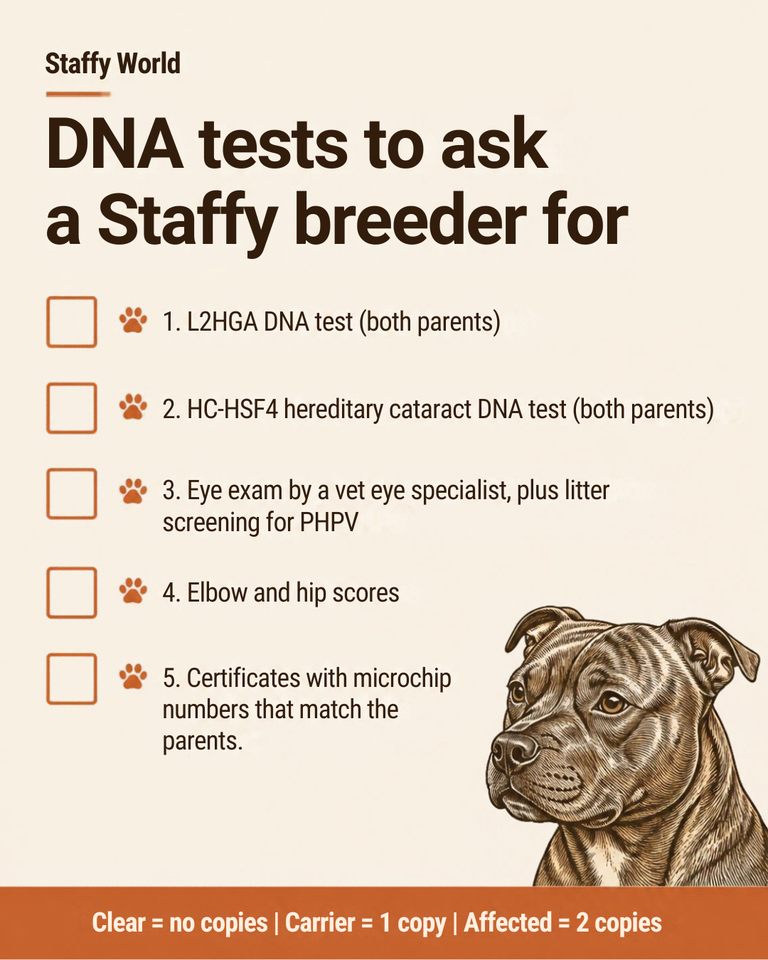
Two inherited conditions matter most in Staffies because each has a reliable DNA test: L2HGA and hereditary cataract (HC-HSF4). A third, PHPV, is an eye condition that’s checked by an eye exam rather than a DNA test. The UK Kennel Club lists both DNA tests, plus eye screening and elbow scoring, as best-practice health testing for the breed.
L2HGA (L-2-hydroxyglutaric aciduria)
L2HGA is an inherited metabolic disorder that affects the brain. An enzyme doesn’t work properly, so a chemical called L-2-hydroxyglutaric acid builds up and damages the nervous system over time. Signs usually appear between six months and a year of age, though some dogs show them later. They include a wobbly or uncoordinated walk, tremors, muscle stiffness, seizures and behaviour changes. Severity varies a lot: some dogs are badly affected young, while others have milder, on-and-off signs that a vet can help manage. There’s no cure, so prevention through DNA testing is what matters.
Hereditary cataract (HC-HSF4)
Hereditary cataract in Staffies is an early-onset cataract caused by a change in the HSF4 gene. It affects both eyes. According to the Kennel Club, it can be diagnosed as early as 8 to 12 weeks of age (puppies aren’t born with it), progresses significantly between two and four years, and leads to blindness if untreated. Cataract surgery exists, but it’s specialist and expensive, which is why breed clubs pushed for the DNA test in the first place.
PHPV (persistent hyperplastic primary vitreous)
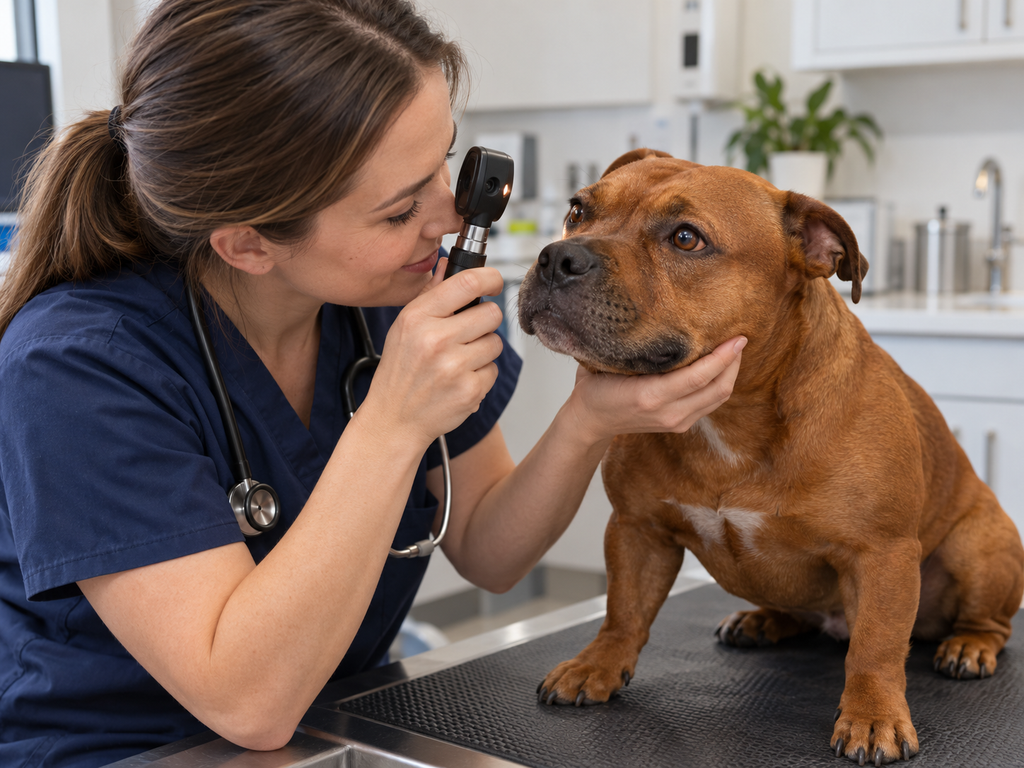
PHPV is a developmental eye defect that forms before birth, when blood vessels behind the lens don’t shrink away as they should. It’s graded from mild to severe. Many mildly affected dogs have normal vision, but severe cases can seriously affect sight. PHPV isn’t usually progressive, and there’s no DNA test. Instead, a veterinary eye specialist checks puppies (ideally at around 6 to 12 weeks, as part of litter screening) and breeding dogs.
How inheritance works
Both L2HGA and HC are autosomal recessive. That means a dog must inherit two faulty copies of the gene, one from each parent, to be affected. A dog with one faulty copy is a carrier: it stays healthy but can pass the gene on. Two carriers bred together can produce affected puppies, which is exactly what DNA testing is designed to prevent.
DNA tests and health checks to ask a breeder for
Before you buy a Staffy puppy, ask to see DNA results for both parents for L2HGA and HC-HSF4, plus eye screening results. A good breeder will be happy to show you the certificates, and many will have tested more than the minimum.
Your breeder checklist:
How to read the results
A red flag: a breeder who says their lines “don’t have problems” and so don’t need testing. You can’t see carrier status by looking at a dog. The only way to know is a test.
Eyes: cataracts and other eye conditions to watch for
The eye problems most associated with Staffies are hereditary cataract and PHPV, covered above. Breed clubs also mention posterior polar subcapsular cataract (PPSC), a small, usually stable lens change that rarely affects vision, as something eye specialists look for during screening.
Signs worth a vet visit:
A painful or suddenly red eye should be seen the same day. Slower changes, like gradual cloudiness, still deserve a booked appointment, because some eye conditions can lead to glaucoma if left alone.
Joints and mobility: hips, elbows, kneecaps and cruciate ligaments
Staffies are muscular, athletic dogs, and joint problems are among the more common reasons they need a vet, but the picture is more mixed than many breed guides suggest.
Watch for limping, stiffness when getting up, sitting with a leg stuck out to the side, “bunny-hopping” with both back legs, or reluctance to jump into the car. Keeping your Staffy lean is the single biggest thing you can do for their joints. Use our Staffy weight chart to check where your dog sits, and avoid lots of repetitive high-impact jumping while a puppy is still growing.
Skin problems
Skin allergies are one of the most common reasons Staffies see the vet. VetCompass found they have almost twice the odds of atopic dermatitis (environmental allergy) compared with other dogs. Typical signs are licking and chewing the paws, a red belly and armpits, rubbing the face and repeated ear infections. Common triggers include grasses, pollens and dust mites, with food allergies less common.
Staffies also get hives, contact reactions to certain grasses, and sun damage on thin white or pink skin. Most skin problems can be managed well once your vet has worked out the cause, so don’t just keep changing shampoos. If you suspect a food link, our guide to the best dog food for Staffies with sensitive skin covers what to look for, and your vet can guide a proper elimination diet. Breed clubs also note that skin problems appear more often in dogs bred from two blue parents, which our Staffy colours guide explains.
Lumps and cancer: why any new lump needs a vet check
Any new lump on a Staffy should be checked by a vet, because Staffies are more prone to skin lumps than most dogs and you can’t tell a harmless one from a mast cell tumour by looking. The 2020 VetCompass study found Staffies had 1.8 times the odds of being seen for a skin mass. A separate VetCompass study (2015) found they had 4.2 times the odds of a mast cell tumour compared with crossbred dogs.
Mast cell tumours are the most common skin cancer in dogs, and they can look like almost anything: a raised bump, a soft lump under the skin, or something that swells, shrinks and reddens. They’re most often found in middle-aged dogs (around eight years is typical), but can appear at any age. The reassuring part is that research suggests these tumours are more likely to be low-grade in bull-type breeds like Staffies, and low-grade tumours caught early can often be treated successfully with surgery.
Your vet will usually take a quick needle sample (a fine needle aspirate) to see what a lump is. It’s fast, cheap and usually done without sedation. A good habit is a monthly nose-to-tail “lump check” while you give your Staffy a rub, and noting the size and location of anything you find.
Seizures
Staffies had about twice the odds of a seizure disorder in the VetCompass study. Seizures can have many causes, including epilepsy, L2HGA, toxins and low blood sugar, so any first seizure needs a vet check. During a seizure, keep your dog away from stairs and hard edges, don’t put your hands near their mouth, and time it. A seizure lasting more than five minutes, or several close together, is an emergency.
Heat, weight and everyday risks
Heatstroke and obesity are two of the most preventable health problems for any Staffy, and in Australia they often go together.
Heat stress and heatstroke
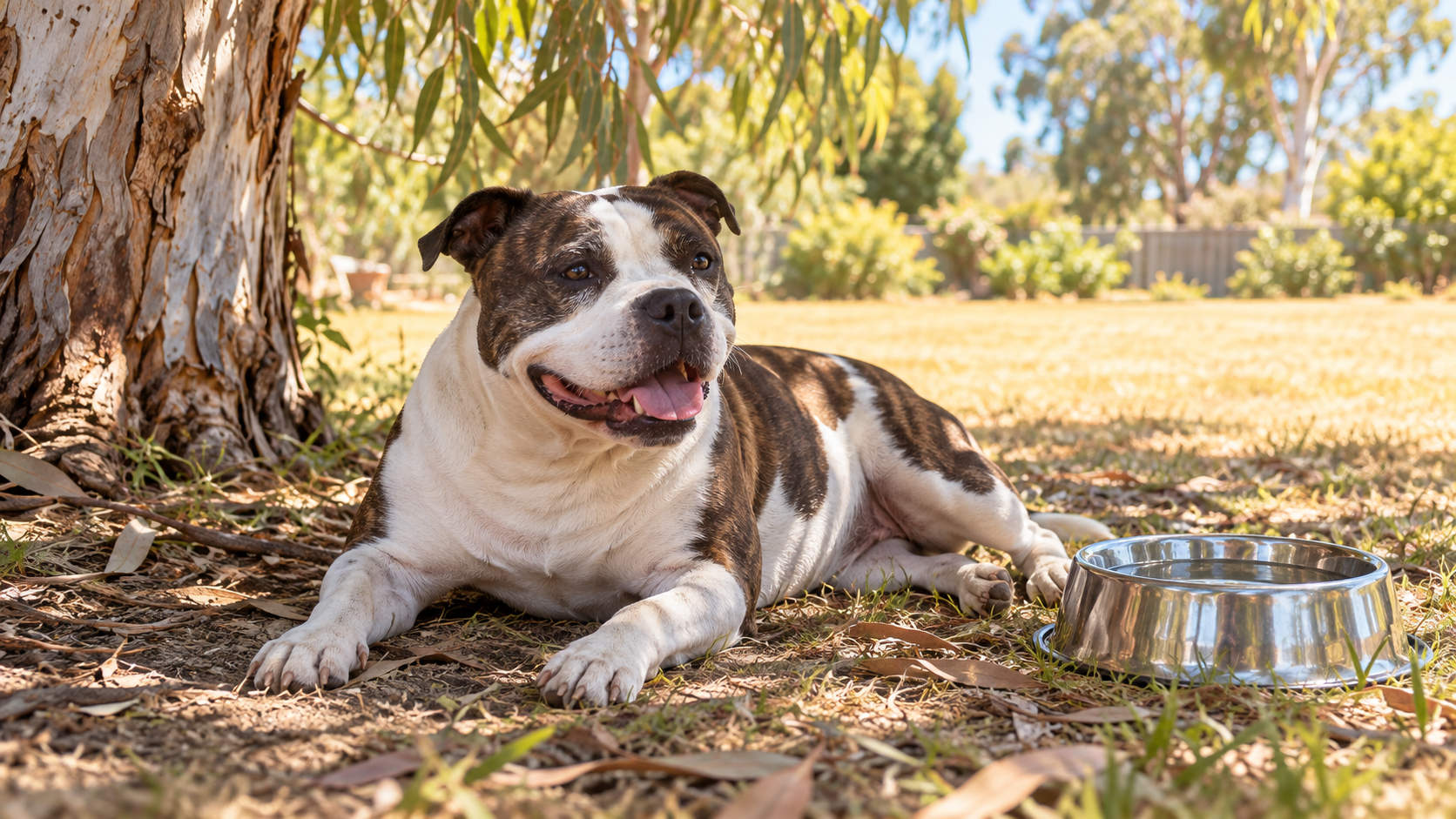
Staffies love to run, and they don’t always know when to stop. A UK VetCompass study found exercise triggered around three-quarters of heatstroke cases in dogs, far more than hot cars, and that dogs heavier than the average for their breed had higher odds of heat-related illness. On hot days, walk early or late, carry water, let your dog rest in the shade, check the footpath with the back of your hand, and never leave a dog in a car.
RSPCA Australia lists the warning signs as constant panting, rapid breathing, pale or red gums, drooling, vomiting, weakness, wobbliness, seizures and collapse. If you suspect heatstroke, move your dog somewhere cool, wet their coat with room-temperature or cool water (not ice-cold), use a fan, and get to a vet immediately, calling ahead on the way.
Weight and obesity
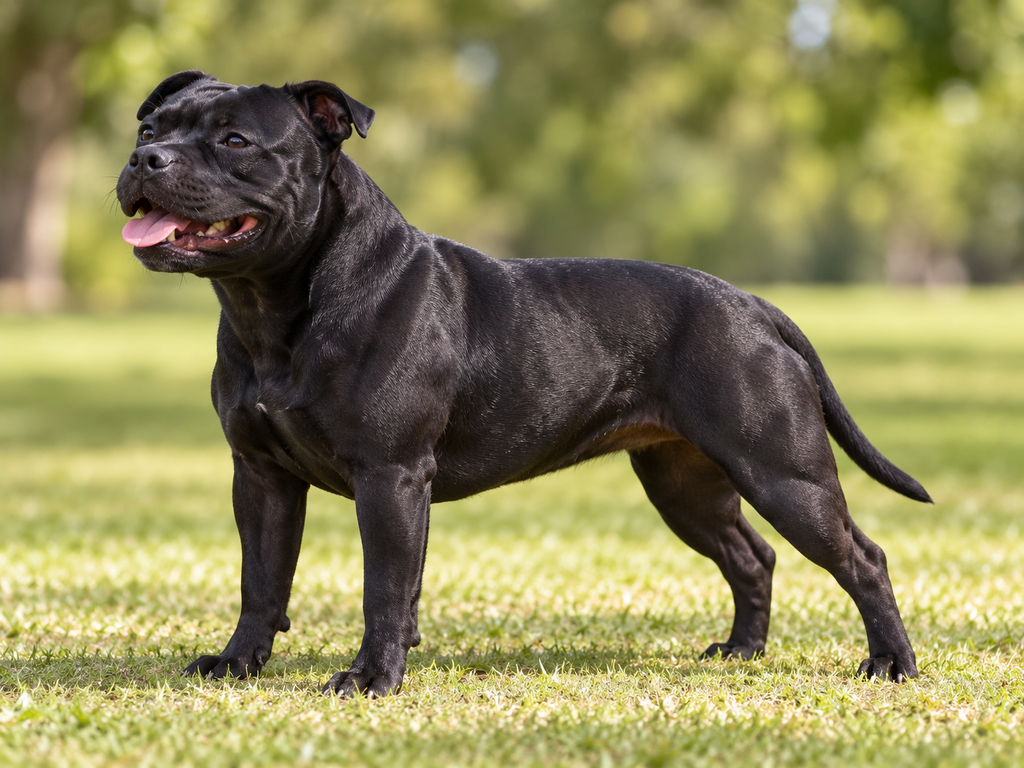
Staffies are food-motivated and built to look solid, so weight gain is easy to miss. A fit adult has a visible waist from above, a tucked-up belly from the side, and ribs you can feel easily. Extra weight strains joints, makes heat harder to cope with, and is linked with shorter lives in dogs generally.
Our Staffy weight chart shows healthy ranges by age and sex, and the Staffy feeding chart helps you set portions. Count treats as part of the daily food, and ask your vet to body-condition score your dog at each visit.
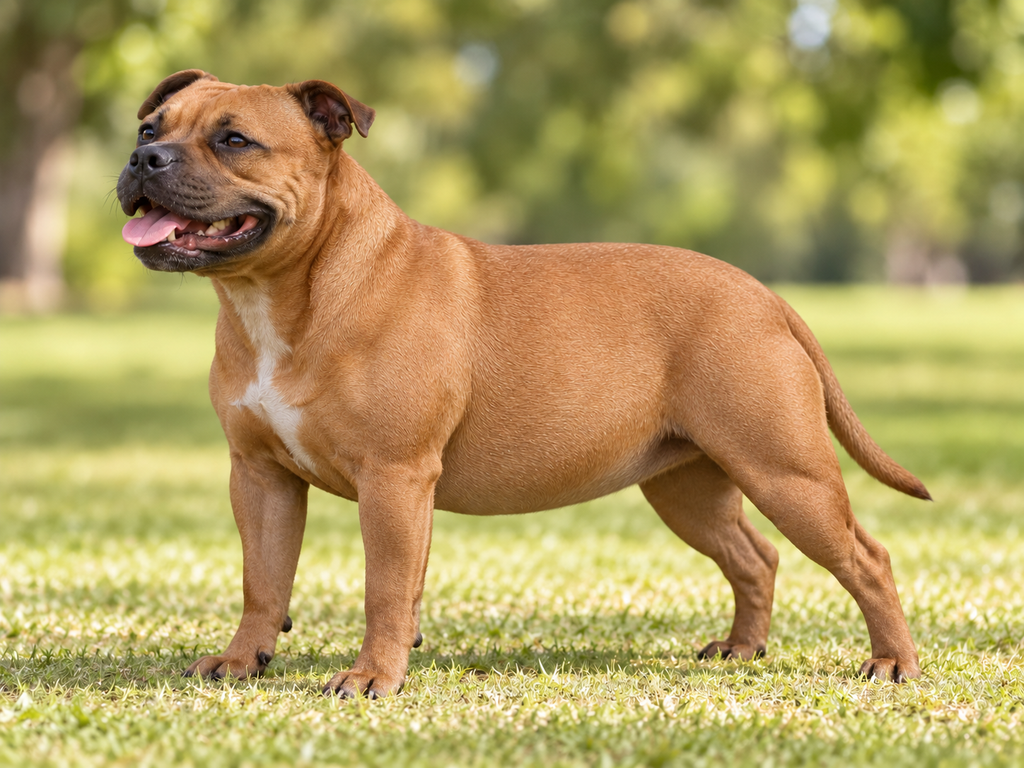
Deafness in white Staffies
Across many breeds, dogs with a lot of white in their coat, especially around the head and ears, are more likely to be born deaf in one or both ears, and a dog deaf in only one ear usually seems to hear normally. If you’re buying a mostly white or heavily pied puppy, ask whether it has had a BAER hearing test. Our guide to Staffy colours covers white and pied coats in more detail.
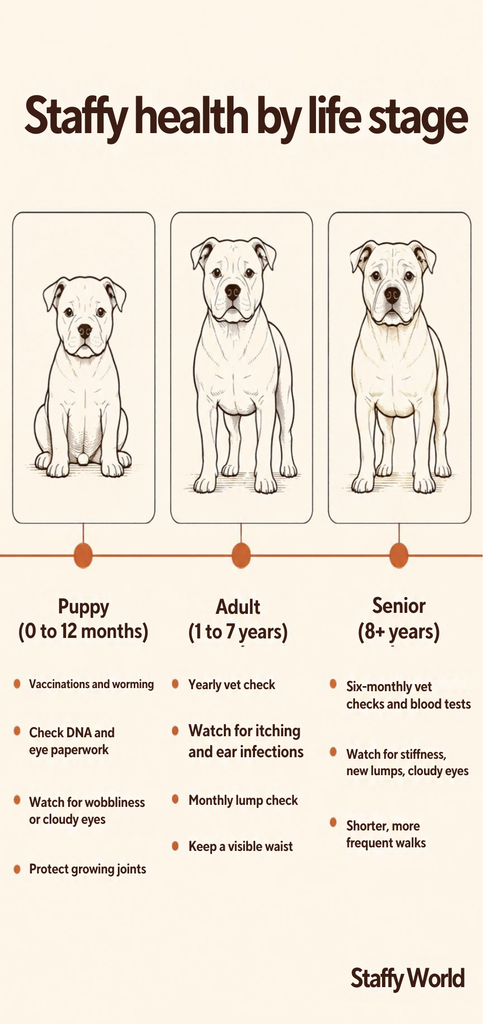
Staffy health by life stage
What you watch for changes as your Staffy ages, but regular vet checks matter at every stage.
For what it’s worth, my Staffy Guinness is three and sees our vet twice a year. Apart from one allergic reaction to a grass in our backyard (since removed), he hasn’t had any health issues, and those routine visits are an easy way to catch small things before they become big ones.
When to see the vet
If you’re unsure, ring your vet and describe what you’re seeing. Here’s a rough guide.
Go now (emergency)
Book an appointment (within a few days)
Staffy health FAQs
Sources and further reading
This article draws on veterinary research, kennel club guidance and animal welfare organisations:
This article is general information from a Staffy owner, not veterinary advice. Always talk to your own vet about your dog’s health.