Black Staffy: Solid Black, Black Brindle and What to Know
Quick answer
A black Staffy is a Staffordshire Bull Terrier with a solid black coat, with or without white markings. Black is an accepted colour in the breed standard, but many Staffies described as black are very dark brindles, and black and tan is not accepted. I found no evidence that a black coat changes a Staffy’s health, size or temperament.
Black is one of the most striking Staffy coats, and one of the most misidentified. A lot of dogs sold or described as black turn out to have faint stripes once you see them in the sun.
This article is a spoke off the main Staffy colours guide, so it goes deeper on black without repeating the overview. I haven’t owned a black Staffy: my own dogs, including Guinness, have all been brindle. I’m also not a vet or a geneticist, so everything here is researched from kennel clubs, veterinary genetics labs and published studies, and I’ve said so where the evidence is thin.
This article contains affiliate links. If you buy through one, Staffy World may earn a small commission at no extra cost to you. See the affiliate disclosure for details.
What is a black Staffy?
A black Staffy is a purebred Staffordshire Bull Terrier whose coat is solid black, either all over or with white markings. It isn’t a separate type or line, just one of the colours the breed comes in.
The Royal Kennel Club breed standard lists black, and black with white, among the accepted colours, and asks for a black nose. The Australian and American standards accept black in near-identical wording. The Royal Kennel Club’s registration list for the breed has separate entries for black, black and white, black brindle and dark brindle, which tells you how often those four get confused.
Is my Staffy solid black or black brindle?
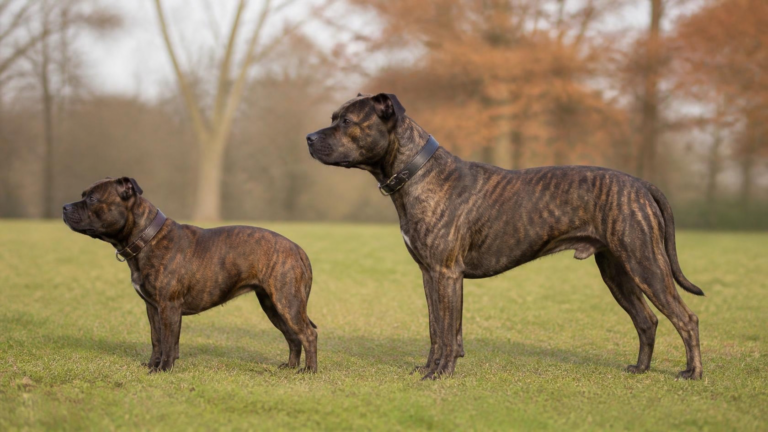
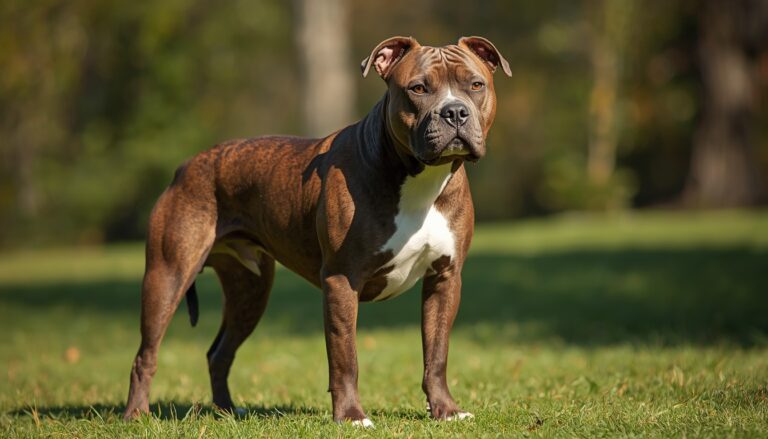
Check the coat in direct sunlight: a solid black Staffy has no stripes anywhere, while a black brindle shows faint brown or red striping, usually on the legs, cheeks and under the chest. Indoors the two can look identical.
The names you’re most likely to come across:
|
Name |
What it looks like |
Accepted in the standard? |
Notes |
|---|---|---|---|
|
Black |
Solid black all over, no stripes in any light |
Yes |
Nose should be black. |
|
Black and white |
Black with white on the chest, feet, face or more |
Yes |
A white chest patch is very common. |
|
Black brindle |
Looks black until the light picks out faint stripes |
Yes (as brindle) |
The coat most often mistaken for solid black. |
|
Dark brindle |
Heavy striping with a little more base colour showing |
Yes (as brindle) |
Reads as dark brown from a distance. |
|
Black and tan |
Black with tan points on the muzzle, eyebrows, chest and legs |
No |
Named as unacceptable in the UK standard. |
|
Blue |
Slate grey, not black |
Yes |
Genetically a diluted black. |
Why are some Staffies black?
A solid black coat in dogs is usually caused by a gene version called dominant black, which fills every pigmented hair with black pigment. The UC Davis Veterinary Genetics Laboratory describes dogs with two copies as having solid black pigment in their coloured areas, and because it’s dominant, one copy from one parent is enough.
The same gene, the K locus, also controls brindle. Laboklin sets out the order: dominant black overrides brindle, and brindle overrides plain red or fawn. So a Staffy can look black for two different reasons: it carries dominant black, or it’s a brindle with striping so heavy that almost no base colour shows.
I couldn’t find a Staffy-specific study showing how many black Staffies fall into each group, so I can’t tell you which is more common. What the genetics does explain is why two black parents can produce brindle, red or fawn puppies, and why a blue Staffy is, underneath, a black one: blue is black pigment diluted by a separate gene.
Why does a black Staffy’s coat turn brown?
A brownish or rusty tinge on a black coat is common, and it’s usually put down to age and sun exposure. That’s what most owners and breeders report, though I couldn’t find a formal study on it in Staffies.
Diet can play a part too. Veterinary nutritionists at Tufts University explain that dogs need enough of two amino acids, tyrosine and phenylalanine, to make black pigment, and that a shortfall can lead to a reddish-brown coat instead. They stress that genetics is the main driver of coat colour and that diet is a secondary factor.
A slow, even fade on an otherwise healthy dog is rarely a concern. If the colour change is sudden or patchy, or comes with hair loss, itching or changes in appetite or energy, book a vet visit and take a list of everything your dog eats.
Do black Staffies overheat more easily?
The limited research available suggests coat colour makes less difference than you’d expect. A small study of 16 Labradors found that black dogs didn’t get measurably hotter than yellow dogs after 30 minutes of walking in direct sun. That’s a small preprint study in a different breed, so I wouldn’t lean on it heavily.
The practical point is that any Staffy can overheat. They’re muscular, enthusiastic and short-muzzled compared with many breeds, so on hot days walk early or late, carry water and give every dog shade, whatever its colour.
Are black Staffies harder to rehome?
The idea that black dogs wait longer in shelters, often called black dog syndrome, isn’t well supported. A study of nearly 16,700 adoption records from two American shelters, published in the journal Animal Welfare, found that black dogs were adopted slightly faster than average.
The same study found the dogs that waited longest were bull breeds: their shelter stays were two and a half to three times the average. That’s American data, not Australian or British, but it’s a reminder that it’s the breed type, not the coat, that tends to count against a Staffy in rescue. If you’re open to adopting, a black Staffy in a shelter is as good a dog as any other colour.
Does a black coat affect health, size or temperament?
I found no evidence that black Staffies differ from other Staffies in health, size or temperament. The breed standard sets one size for every colour: 36 to 41 cm at the shoulder, with dogs at 13 to 17 kg and bitches at 11 to 15.4 kg. The Staffy weight chart shows what’s normal by age.
The inherited conditions to ask a breeder about are breed-wide, not colour-linked, and the Staffy health problems guide covers them. If your dog has a lot of white, the pale skin under it is more prone to sunburn; the skin problems guide has more.
What about black and tan Staffies?
Black and tan is not an accepted colour: the Royal Kennel Club standard names black and tan, along with liver, as unacceptable. A black and tan dog has tan points in a set pattern, typically the eyebrows, muzzle, chest and lower legs, like a Rottweiler or Dobermann.
That doesn’t make a black and tan Staffy unhealthy, and the colour alone isn’t proof of a cross. It does mean the dog can’t be shown successfully, and a breeder charging more for the colour as “rare” is selling a fault as a feature. Don’t confuse it with black brindle, where the lighter colour appears as stripes, not as neat points.
How do you look after a black Staffy?
The coat needs the same simple care as any Staffy’s: a weekly brush and the occasional bath. The one thing that’s different about owning a black dog is visibility, because a black Staffy all but disappears on an evening walk.
A reflective or LED dog collar is the easy fix. It lets drivers, cyclists and you see where the dog is once the light goes. Look for one that’s rechargeable and visible from every side, and treat a light-up collar as an extra, worn with a proper collar or harness that can take a Staffy’s pull. The Staffy harness guide covers that side.
In winter, a black coat is no warmer than any other. The Staffy clothing guide explains when a coat helps and how to size one.