Brindle Staffy: Shades, Genetics and What to Expect
Quick answer
A brindle Staffy is a Staffordshire Bull Terrier with dark stripes over a red or fawn base coat. Brindle is a pattern, not a separate colour, type or breed, and the breed standard accepts any shade of it, with or without white. I found no evidence that brindle changes a Staffy’s health, size or temperament.
All three of my Staffies have been brindle. Middy was the dog I grew up with, Schooner saw me through most of my adult life, and Guinness, who is three, is a mid brindle: an even mix of dark stripes over a brown base. So this is the one colour article on the site where I’m writing about dogs I’ve actually lived with.
It’s a spoke off the main Staffy colours guide, so it goes deeper on brindle and doesn’t repeat the overview. I’m not a vet or a geneticist. The genetics and breed-standard details below come from kennel clubs and veterinary genetics labs, and I’ve said so wherever the evidence is thin.
This article contains affiliate links. If you buy through one, Staffy World may earn a small commission at no extra cost to you. See the affiliate disclosure for details.
What is a brindle Staffy?
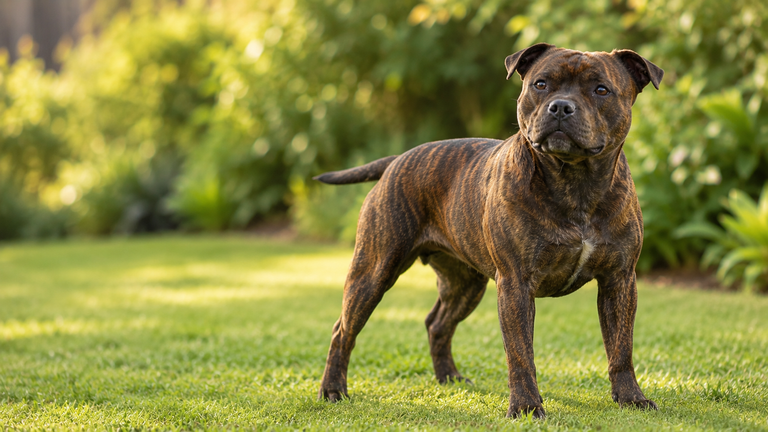
A brindle Staffy is a purebred Staffordshire Bull Terrier whose coat has dark stripes running over a lighter red or fawn base. The stripes are irregular, a bit like a tiger’s, and they can be so sparse the dog looks mostly red or so dense it looks almost black.
Brindle is one of the colours written into the breed standard. The Royal Kennel Club breed standard accepts any shade of brindle, or any shade of brindle with white, and the Australian and American standards use near-identical wording. That means a brindle Staffy isn’t a special type and it isn’t a sign of a cross. It’s one of the most traditional looks the breed has.
What shades of brindle Staffy are there?
Brindle runs on a sliding scale from light to very dark, and the names people use for the shades are a mix of kennel club registration terms and informal labels. The Royal Kennel Club’s list of registration colours for the breed includes brindle, dark brindle, black brindle, red brindle and blue brindle, plus versions of each with white.
Here’s how the common names line up:
|
Name |
What it looks like |
Registration term? |
Notes |
|---|---|---|---|
|
Brindle (mid brindle) |
An even mix of dark stripes over a brown or fawn base |
Yes |
The classic look. Guinness is a mid brindle. |
|
Red brindle |
Bold dark stripes over a clearly red base |
Yes |
Sometimes called tiger brindle, which is an informal name. |
|
Dark brindle |
Heavy striping with only small amounts of base colour showing |
Yes |
Often looks plain dark brown from a distance. |
|
Black brindle |
So heavily striped the dog looks black until the light hits it |
Yes |
Commonly mistaken for solid black. |
|
Blue brindle |
Grey-blue stripes over a paler fawn base |
Yes |
Brindle on a dog that also has the blue dilution. |
|
Brindle and white |
Any brindle shade with white on the chest, feet, face or more |
Yes |
Mostly white dogs with brindle patches are registered as pied. |
|
Reverse brindle |
Looks like light stripes on a dark coat |
No |
An informal name for heavy brindle. The pattern itself is the same. |
Why are some Staffies brindle?
A Staffy is brindle because it carries the brindle version of a gene known as the K locus. That version lays dark stripes over what would otherwise be a plain red or fawn coat.
Laboklin, a veterinary genetics lab, describes three versions of this gene in a set order of dominance: dominant black, then brindle, then the version that lets a dog’s red or fawn base show through untouched. Because brindle sits above plain red and fawn in that order, a dog needs only one copy from one parent to be brindle.
In practice, that explains a few things breeders and owners notice:
Testing for brindle is less tidy than for other colours. The standard K locus test at Laboklin checks for the dominant black and non-brindle versions only, with brindle offered as a separate test, and the UC Davis Veterinary Genetics Laboratory notes its test doesn’t identify brindle directly. For most owners that doesn’t matter: you can see whether your dog is brindle.
Is my Staffy black or very dark brindle?
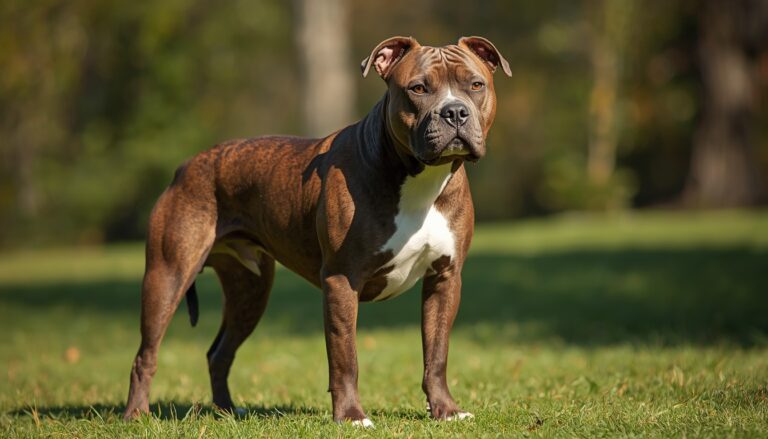
Take the dog into direct sunlight and look at the legs, cheeks and under the chest: if you can see faint brown or red stripes, it’s a black brindle and not a solid black. This is the most common colour mix-up in the breed, because a heavily striped coat looks solid black indoors.
It makes no practical difference to the dog. Black and brindle are both accepted colours, and both are registration options. It only matters if you’re filling in registration papers or trying to work out what colours a litter might be.
Are brindle Staffies rare?
No. Brindle is widely regarded as one of the most common and traditional Staffy coats, although I couldn’t find official registration figures broken down by colour to put a number on it. Treat any ad describing a brindle puppy, or a particular shade such as “reverse” or “tiger” brindle, as rare with caution. The shade names are descriptions, not separate or scarcer varieties.
Does brindle affect health, size or temperament?
I found no evidence that brindle Staffies differ from other Staffies in health, size or temperament. The breed standard sets the same size for every colour: 36 to 41 cm at the shoulder, with dogs at 13 to 17 kg and bitches at 11 to 15.4 kg. The Staffy weight chart has the full picture by age.
The health conditions worth knowing about apply to the breed as a whole, and the Staffy health problems guide covers the DNA tests to ask a breeder about. The one coat-related point is white: a brindle and white dog with a lot of white has pale skin under those patches, which burns more easily in the sun. The skin problems guide goes into that.
Do brindle Staffy puppies change as they grow?
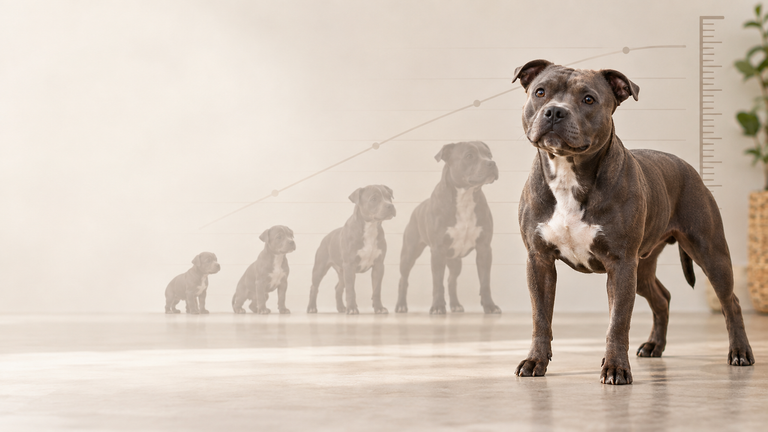
The pattern a puppy is born with stays, but how it looks can shift a little as the adult coat comes in. Owners commonly report stripes becoming clearer or the overall coat looking slightly lighter or darker by adulthood. I couldn’t find a formal study on this in Staffies, so take it as general guidance. What doesn’t happen is a brindle puppy turning into a plain red or black adult.
Brindle Staffy, brindle Amstaff or brindle pit bull?
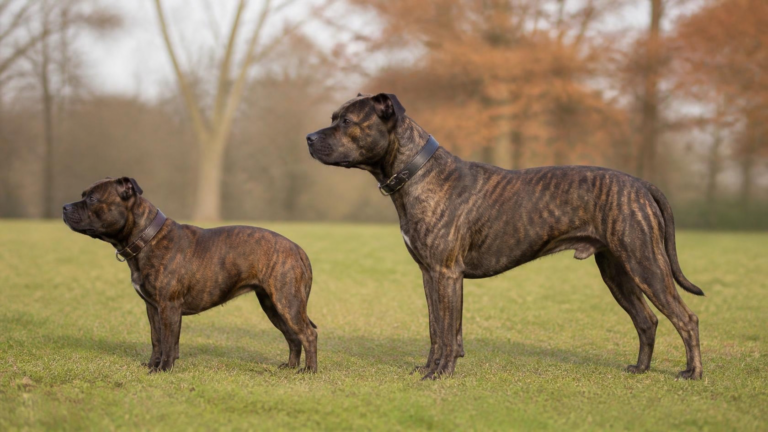
Brindle appears in several bull-breed relatives, so the coat alone can’t tell you which breed you’re looking at. Size is the better guide: a Staffy stands 36 to 41 cm at the shoulder, and the American breeds are taller and heavier. The types of Staffy guide sets out the differences.
How do you look after a brindle coat?
Exactly as you would any other Staffy coat: it’s short, smooth and low-maintenance. A quick weekly brush lifts loose hair and gives you a chance to check the skin, and brindle has the bonus of hiding dirt better than most colours.
The tool I use on Guinness is a rubber grooming mitt. For a short single coat it does the job without scratching: soft nubs loosen dead hair, and most dogs treat it as a pat. Look for one with flexible rubber or silicone tips and a strap that keeps it on your hand.
Staffies have little insulation whatever their colour. If yours shivers on winter walks, the Staffy clothing guide covers sizing a coat for a deep chest.
One Comment