Fawn and Red Staffies: Shades, Genetics and What “Brown” Really Means
Quick answer
Fawn and red Staffies carry the same yellow-red pigment: fawn is the lighter end of the range and red is the deeper end. Both colours are accepted in every major breed standard, with or without white, and both should have a black nose. Most Staffies described as “brown”, “tan” or “sandy” are really fawn, red or brindle. A truly brown coat with a brown nose is liver, which the standards do not accept.
If you have ever typed “brown Staffy” into a search bar, you are in good company. “Brown” is not a colour in any Staffordshire Bull Terrier breed standard, yet it is how plenty of owners describe their dog. This guide sorts out what a fawn Staffy and a red Staffy actually are, how to tell them from liver and brindle, and why the exact shade matters far less than people think.
I am not a vet or a geneticist, and my own Staffy, Guinness, is brindle, so this article is research, not lived experience. For every coat and pattern in one place, start with the Staffy colours guide.
This article contains affiliate links. If you buy through them, Staffy World may earn a small commission at no extra cost to you. See our affiliate disclosure.
What is a fawn Staffy, and what is a red Staffy?
A fawn Staffy has a light tan coat, anywhere from pale sandy cream to warm biscuit, and a red Staffy has a deeper coat that runs from ginger through to rich chestnut. Both are solid colours built from the same pigment, and both can come with white markings.
The breed standards treat them as two named colours without saying where one stops and the other starts. The Royal Kennel Club breed standard, updated on 1 November 2025, lists red and fawn among the accepted colours and allows either with white. The standard used in Australia, the FCI standard and the AKC standard name red and fawn in the same way.
All of them ask for a black nose. The updated UK wording allows a slightly lighter nose only in blue dogs, so that allowance does not apply to a fawn or red Staffordshire Bull Terrier.
Fawn vs red: what is the actual difference?
The difference is depth of shade, not a different colour gene. Fawn and red are both made from phaeomelanin, the yellow-red pigment, and a dog simply produces it in a paler or richer tone.
Researchers who measured that pigment across many breeds found that five genetic variants explained over 70% of the variation in how intense it is, from cream through to deep red. Several genes each nudge the shade, which is why Staffies come in a smooth range instead of two neat boxes. That study looked at dogs in general, not Staffies specifically.
In practice, where “dark fawn” ends and “light red” begins is a judgement call. Two people can describe the same dog differently, and neither is wrong.
Is my Staffy brown, fawn, red or liver?
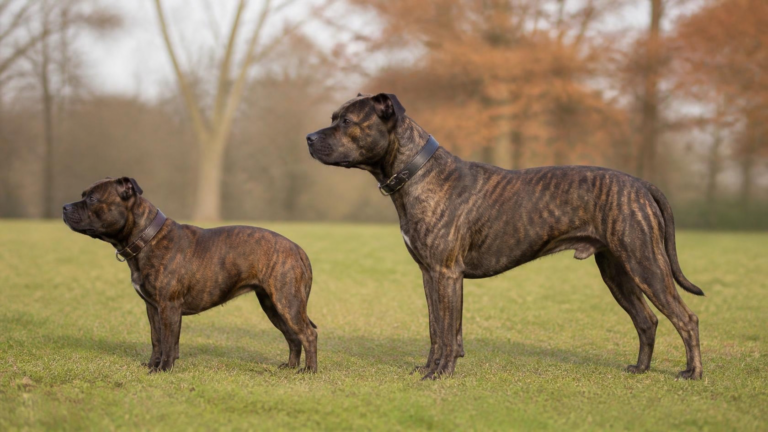
Most “brown” Staffies are fawn, red or brindle, and the quickest check is the nose. A black nose on a tan-to-chestnut coat means fawn or red. A brown nose with a brown coat points to liver.
Here is how the everyday colour words map to the correct terms:
|
Everyday word |
Correct term |
How to tell |
In the standard? |
|---|---|---|---|
|
Sandy, beige, light brown |
Fawn |
Pale tan coat, black nose |
Yes |
|
Tan, gold |
Fawn or light red |
Mid-tan coat, black nose |
Yes |
|
Orange, ginger |
Red |
Warm red coat, black nose |
Yes |
|
Dark brown, no stripes |
Deep red |
Chestnut coat, black nose |
Yes |
|
Brown with stripes |
Brindle |
Dark stripes over fawn or red |
Yes |
|
Chocolate |
Liver |
Brown nose and eye rims |
No |
|
Silvery beige |
Blue fawn |
Washed-out fawn, grey nose |
Not named |
Why are some Staffies fawn or red? The genetics, simply
A Staffy is fawn or red when its coat is made almost entirely of yellow-red pigment, with little or no black pigment over the top. Dogs make two pigments, black-based eumelanin and red-based phaeomelanin, and a handful of genes decide where each one goes.
Across dog breeds, a clear red or fawn coat usually comes about in one of two ways. The first is the A locus (agouti), where the dominant “fawn or sable” version gives a red-based coat, sometimes with dark-tipped hairs. The second is the E locus, where two copies of “recessive red” stop black pigment in the coat altogether. I could not find a published study that says which route Staffies use. Fawn and red Staffies often show black masks and dark tipping, which recessive red dogs cannot have, so the A locus is the likelier explanation. Treat that as reasoning, not proven fact.
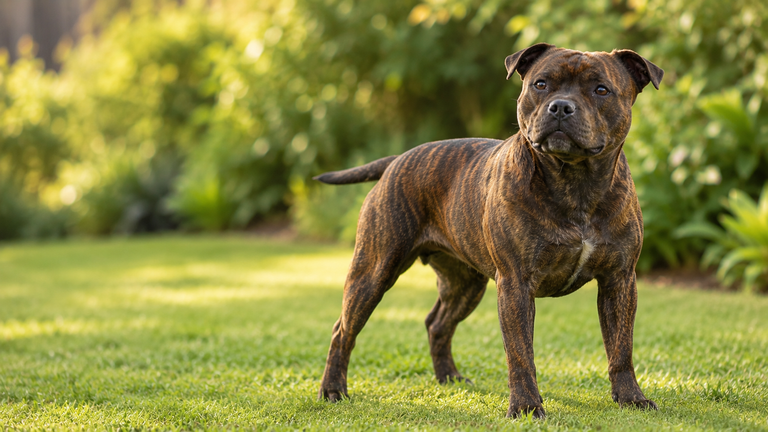
Brindle sits on a third gene, the K locus. Laboklin describes three versions in order of dominance: solid black, brindle, and a recessive version that lets the A locus pattern show. A brindle Staffy is, in effect, a fawn or red dog with dark stripes laid over the top, and my brindle boy Guinness is exactly that. A dog without the brindle version is plain fawn or red.
Dilution, the gene behind blue, is a separate story. A fawn dog with two copies becomes a “blue fawn”: a washed-out, silvery fawn with a grey nose.
What about fawn and white, red and white, black masks and “smut”?
White markings, black masks and sooty overlays are all additions to a fawn or red coat, not separate colours. The standards accept red or fawn with white, so a fawn and white Staffy with a white chest, feet or blaze is squarely within them.
A black mask is dark pigment over the muzzle. Genetics labs describe it as a dominant variant that shows best on lighter coats, and note that a white muzzle can hide it completely.
“Smut” is breeder shorthand for dark-tipped hairs scattered through a red or fawn coat, which gives a sooty look over the head, back or tail. The word is borrowed from other bull breeds. It is not in the Staffy standard, and I could not find a formal definition for this breed, so read “red smut” as a description, not an official colour.
Is a liver Staffy the same as a red Staffy?
No. Liver is a different pigment change, and the nose gives it away. Liver dogs have two copies of the recessive brown gene (the B locus), which turns all black pigment brown. The UC Davis Veterinary Genetics Laboratory notes that this gene leaves red pigment alone but turns the nose and paw pads brown, even on a red or yellow coat.
So a red Staffy has a black nose, dark eye rims and black pads. A liver Staffy has a brown nose and brown eye rims, often with lighter, amber-toned eyes.
The UK standard lists liver, along with black and tan, as unacceptable. The Australian wording calls both highly undesirable, and the AKC disqualifies them. That is a show-ring and breeding rule, not a health verdict: I found no evidence that liver itself harms a dog. It is not proof of crossbreeding on its own either, because a recessive gene can stay hidden for generations.
Do fawn and red Staffy puppies change colour?
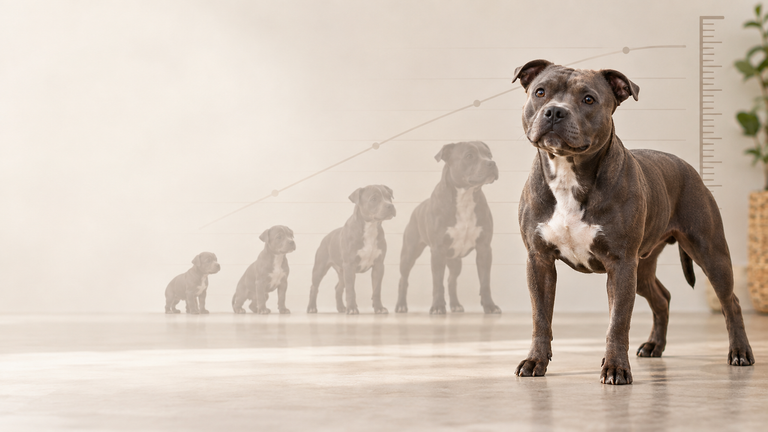
Often a little, yes. Many fawn and red puppies are born with a dusky, dark-tipped coat that clears as the adult coat comes through, so a sooty-looking pup can finish as a clean fawn or red. The shade can also deepen or lighten slightly through the first year.
This is general guidance from how these coats behave across breeds. I could not find a Staffy-specific study. What will not change is the type of nose pigment: a black-nosed puppy does not grow into a liver adult.
Are fawn or red Staffies different in health, size or temperament?
No. I found no evidence that fawn or red Staffies differ from other colours in health, size or temperament. The standard sets one size for every colour, 36 to 41cm at the shoulder, and the Staffy weight chart applies to all of them. The conditions worth knowing about are covered in Staffy health problems, and none of them is tied to a red or fawn coat.
The one thing that does matter is white. A Staffy with a lot of white can have pink, unpigmented skin on the nose, ears and belly, and that skin burns more easily. The Merck Veterinary Manual also links inherited deafness in dogs to white pigmentation, particularly in piebald breeds. Both are about how much white a dog has, not whether the rest of the coat is fawn, red or brindle. Our Staffy skin problems guide covers sore and irritated skin.
For pale patches, shade and staying out of the midday sun come first. For the parts you cannot cover, the AKC’s chief veterinary officer suggests sunscreen on the bridge of the nose, ear tips, groin and inner thighs. A dog-safe sunscreen should be made for dogs, fragrance-free and water-resistant, and it should not contain zinc oxide or PABA, which are toxic if a dog licks them off. Test a small patch first, and reapply after swimming.
Is a red Staffy the same as a red nose pit bull?
No. They are different breeds, and “red” means different things. A red Staffy is a Staffordshire Bull Terrier with a red coat and a black nose. “Red nose” describes an American Pit Bull Terrier with a copper-red nose, usually with a matching red coat. The United Kennel Club standard for that breed allows any nose colour, and its dogs are taller and heavier, at roughly 43 to 53cm and up to 27kg.
A Staffy-sized dog with a reddish-brown nose is better described as liver, or it may be a cross. Types of Staffy explains how the breeds differ.
Choosing a puppy by colour: what matters more?
Health testing and temperament matter far more than shade. A fawn or red coat tells you nothing about a puppy’s health, and a “rare colour” label tells you even less.
Before you ask about colour, ask the breeder about:
If your dog’s background is unknown, or you just want to settle the fawn-or-liver question, a breed-and-health dog DNA test reports the colour genes covered above alongside breed health markers. Look for one that lists the A, K, B and D loci in its results and screens for L-2-HGA and hereditary cataracts. It adds to a breeder’s paperwork and your vet’s advice. It does not replace either.
Staffy World pick
Dog DNA test kit
Chosen to match the advice above. Check the size and materials on the listing before you buy.