Best Dog Beds for Staffies: What Actually Lasts
Quick answer
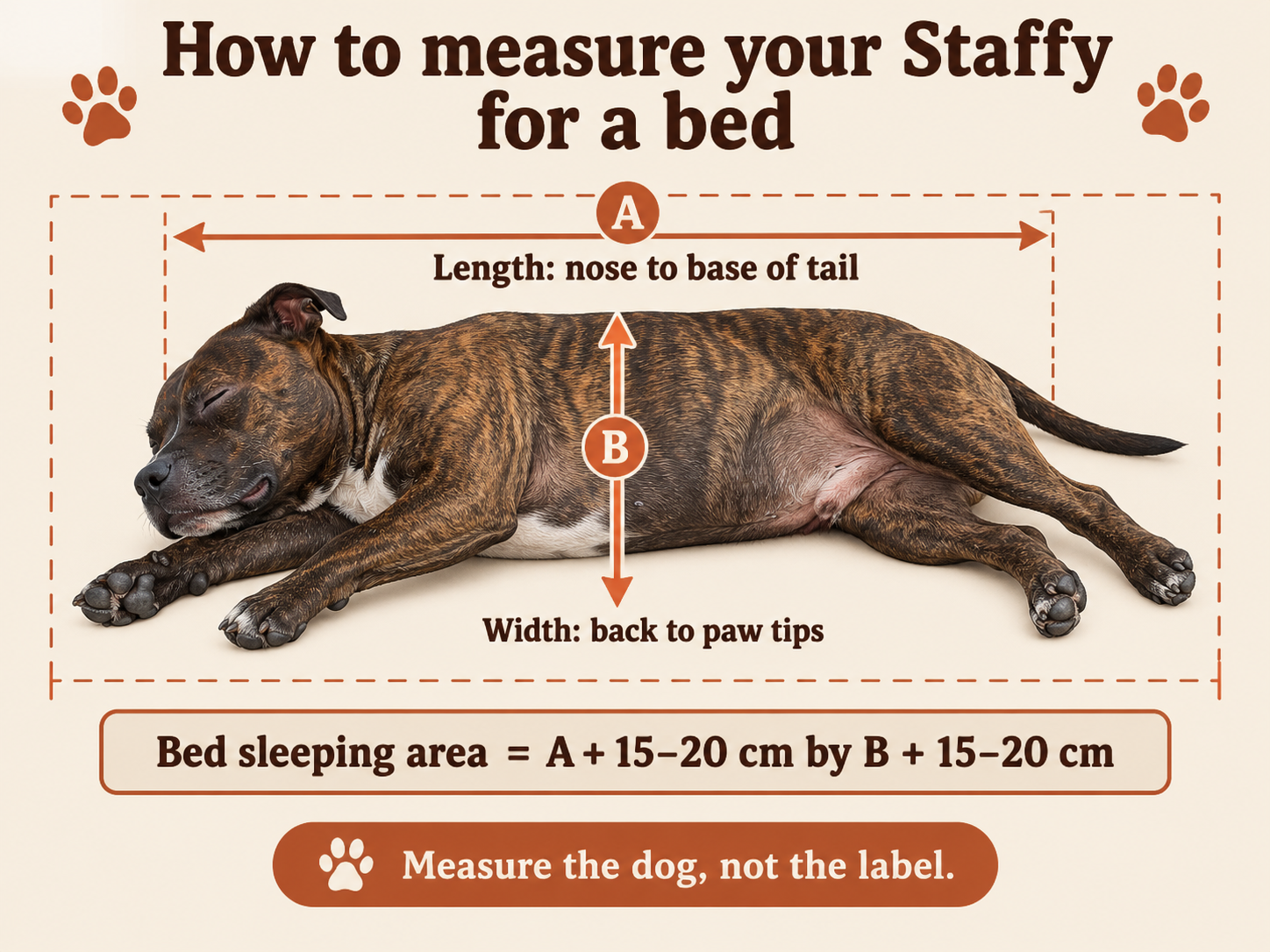
Most adult Staffies do best on a rectangular solid-foam bed with a removable, machine-washable cover, big enough for the dog to lie flat on its side with legs out. Measure your Staffy from nose to the base of the tail while they are stretched out, add about 15 to 20 cm, and buy by those measurements, not by a Medium or Large label. If your Staffy chews bedding, start with a raised frame bed and supervise, because no fabric bed is truly chew-proof.
A Staffy is a lot of dog in a small frame. They are heavy for their height, they sleep hard, and plenty of them dig, circle and flop before settling. That combination flattens thin beds quickly and finds every weak seam.
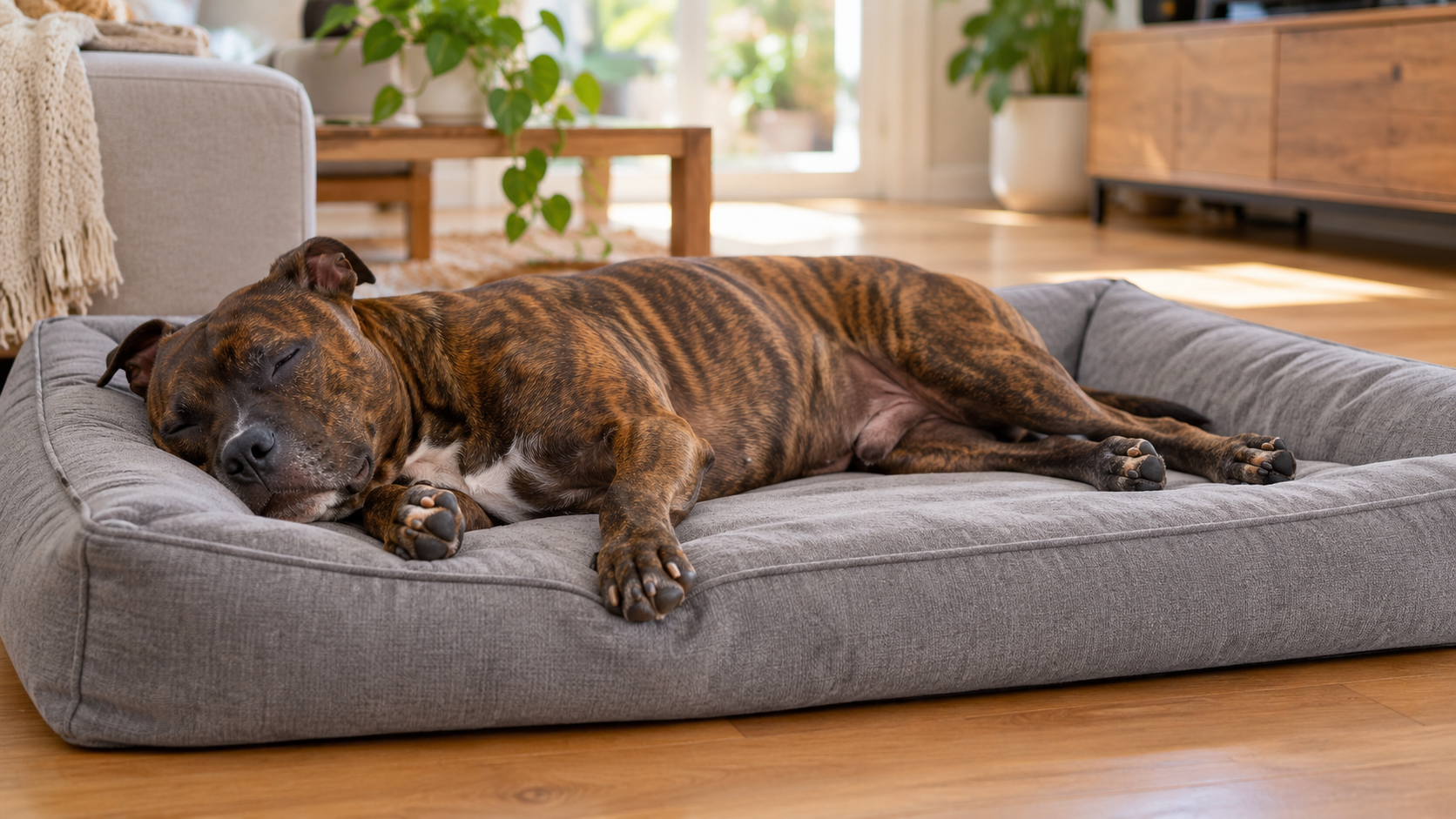
Guinness, my three-year-old brindle Staffy, weighs 28 kg and has three beds indoors to choose from: mine, one in the office where he snores while I work, and one in his cubby, which is what we call his crate. He also has a bouncer bed outside for the days he would rather sleep in the yard. He has never destroyed a bed, and I put that down to luck, so the advice on chewers below comes from research, not from him.
Affiliate disclosure: Some links on this page are Amazon affiliate links. If you buy through them I may earn a small commission at no extra cost to you. It never changes what I recommend. Read the full affiliate disclosure.
Staffy dog beds at a glance
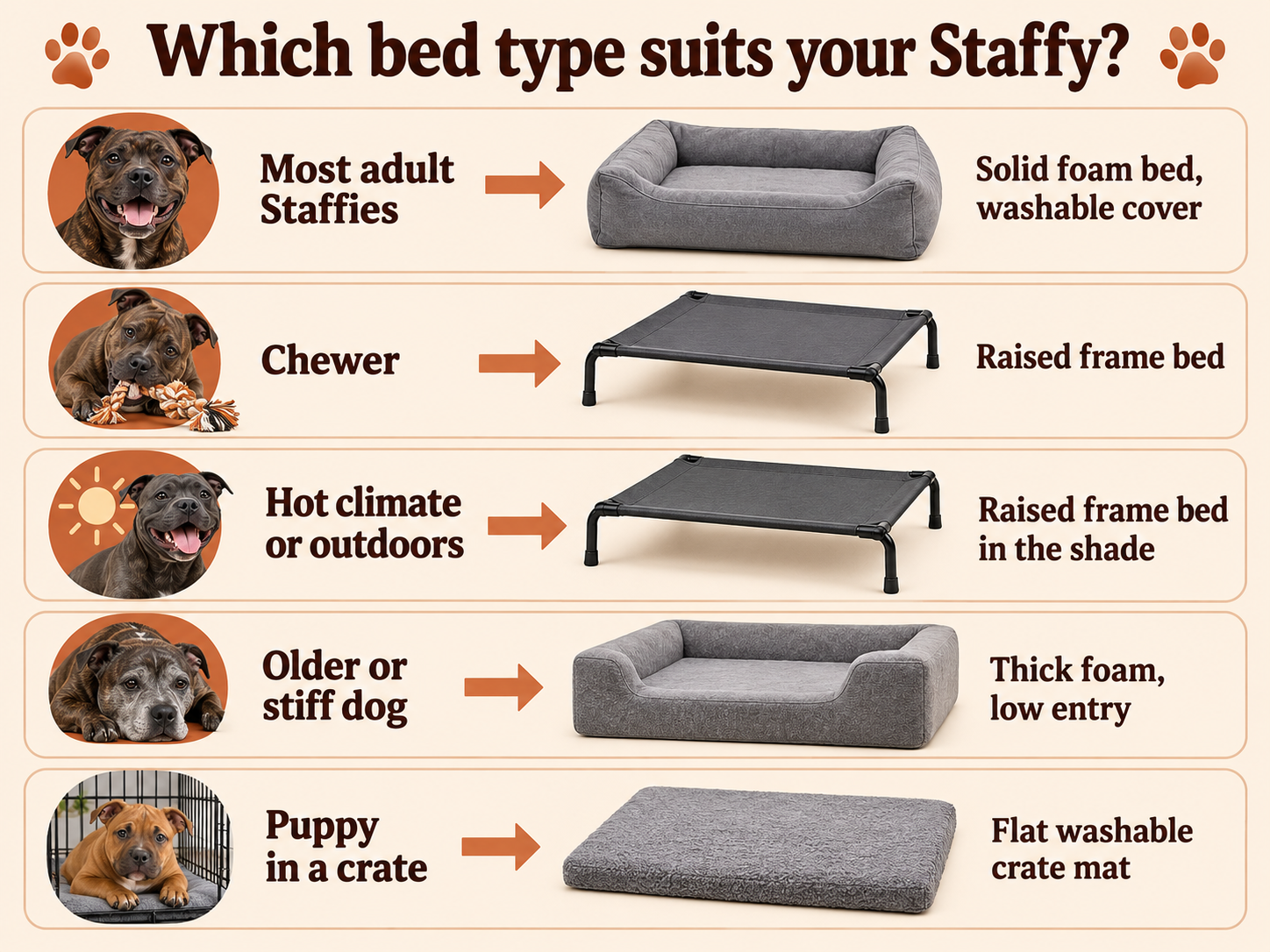
The right bed depends on your dog’s age and habits more than on a size label. Here is the short version.
|
Best for |
Bed type |
Why it suits a Staffy |
Pick |
|---|---|---|---|
|
Most adult Staffies |
Solid foam, washable cover |
Supports a heavy, muscular build |
Orthopaedic foam bed |
|
Chewers, heat, outdoors |
Raised frame bed |
Little to grip; air flows under |
Raised frame bed |
|
Budget or second bed |
Washable bolster bed |
Cheap to replace; head rest |
Washable bolster bed |
|
Older or stiff Staffies |
Thick foam, low entry |
Cushions joints; easy step on |
Thick low-entry foam bed |
|
Crates and puppies |
Washable crate mat |
Fits the crate; washes fast |
Washable crate mat |
How we chose
These picks are chosen on features and fit for the breed, not on lab testing. I have not tested every bed on the market and I will not pretend otherwise. Only the picks marked as Guinness’s are first-hand.
What is first-hand is life with a 28 kg Staffy who treats every soft surface in the house as his. What is research is the guidance on joint support, heat and cold, washing and swallowed bedding, which comes from veterinary and animal welfare sources listed at the end. Where the evidence is thin, I say so.
I am not a vet. If your Staffy is stiff, limping or itchy, or has eaten part of a bed, talk to your vet.
The best dog beds for Staffies
The best dog beds for Staffies are solid foam beds with washable covers for most adults, raised frame beds for chewers and hot weather, and simple washable mats for crates and puppies. The five picks below are in order of how many Staffy owners each one suits.
The buttons go to Amazon. I may earn a commission if you buy, at no extra cost to you.
In a hurry? Start here
Pick 1 · Best overall
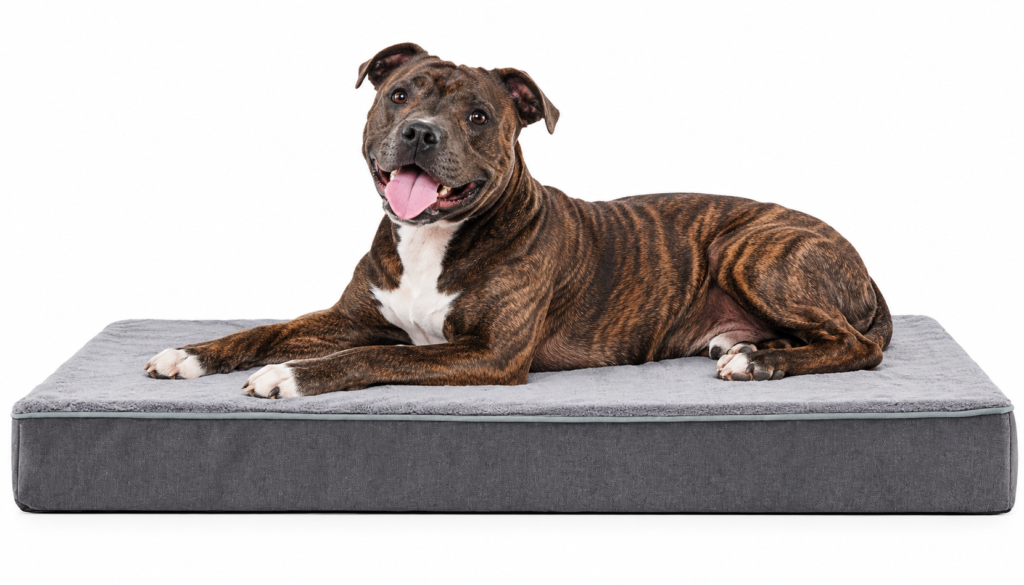
Best overall: orthopaedic foam bed
The bed most adult Staffies should sleep on.
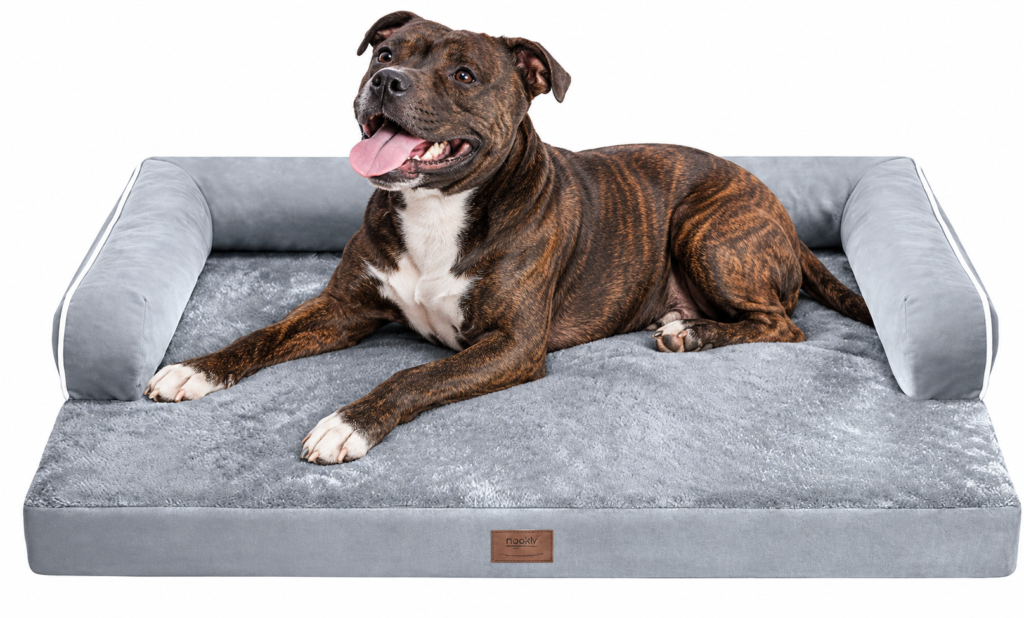
For most adult Staffies, a rectangular orthopaedic foam bed with a removable, washable cover is the one to buy. A Staffy carries a lot of weight on a short frame, and a slab of solid foam spreads that weight better than loose polyester fill, which shifts and packs down where the dog lies most. Padding over hard floors has veterinary backing too: VCA Animal Hospitals explains that repeatedly lying on hard surfaces can cause fluid-filled swellings called hygromas over bony points such as the elbow, and suggests foam beds for padding. Hygromas are mainly a large-breed problem, but the principle holds for any heavy dog.
Before you buy, check three things. The foam should be thick enough that your dog does not sink through to the floor: press your hand down firmly in the middle, and if you can feel the floor, so will your dog’s elbows. The cover should zip off completely and go in the washing machine. And a waterproof liner between the cover and the foam is worth having, because wet foam is hard to clean and slow to dry. Choose an orthopaedic foam dog bed by its measurements, using the method further down.
Look for: solid foam, a zip-off washable cover and a waterproof liner
Good for
Not ideal for
Pick 2 · Chewers and hot weather
Best for chewers and hot weather: raised frame bed
No stuffing to pull out, and air underneath on hot days.
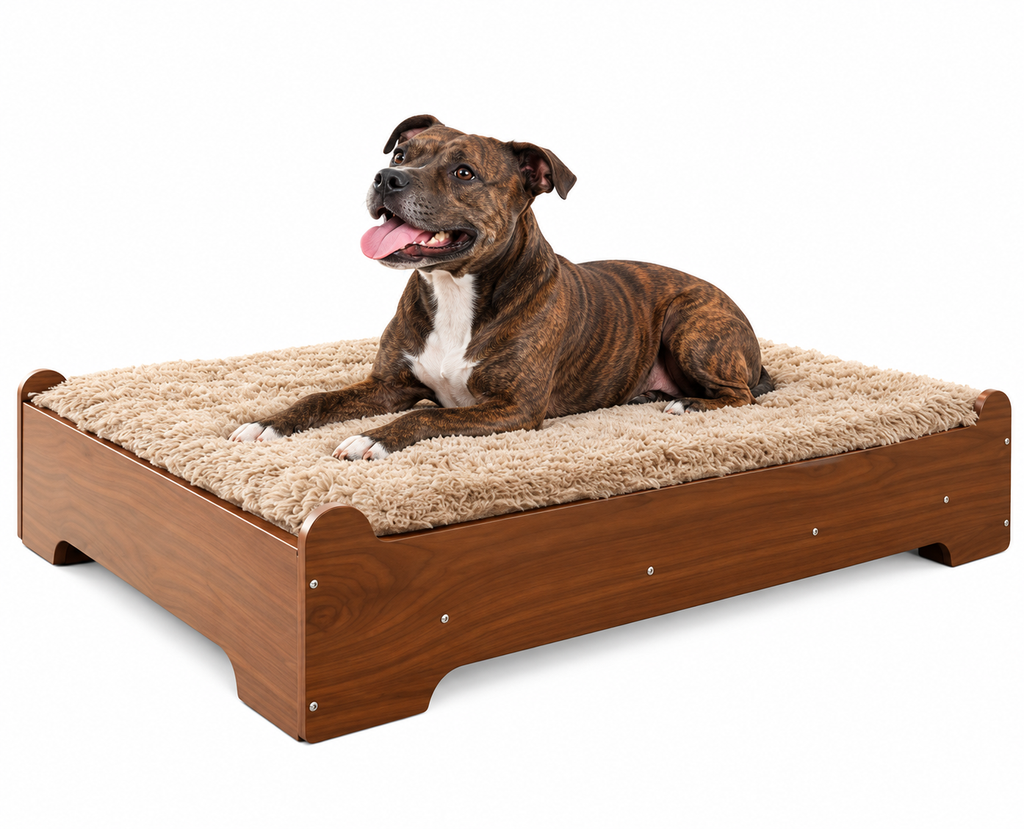
If your Staffy chews bedding, or spends summer days outside, a raised frame bed is the practical choice. It is a sheet of tough fabric or mesh stretched over a frame, so there is no stuffing to pull out and far less for teeth to get hold of. Air moves underneath, and the dog is lifted off hot pavers or cold concrete. RSPCA Australia’s hot-weather advice is that dogs should have a cool, shaded, well-ventilated place to rest at all times, and a raised bed in the shade is one way to provide it.
Be realistic about the word “chew-proof”. A determined dog can damage any fabric, and chew warranties usually cover the frame and certain fabrics for a limited period, and may exclude mesh, pads and cosmetic damage. Read the terms before relying on one. A raised bed also gives no cushioning and little warmth, so it is not the best main bed for an older or stiff dog, or for winter nights. Look for a raised frame dog bed with a metal frame, a weight rating comfortably above your dog’s weight, and replaceable fabric.
Look for: a metal frame, a weight rating above your dog’s and replaceable fabric
Good for
Not ideal for
Pick 3 · Best budget
Best budget: washable bolster bed
A cheap, washable bed for a young dog or a second room.
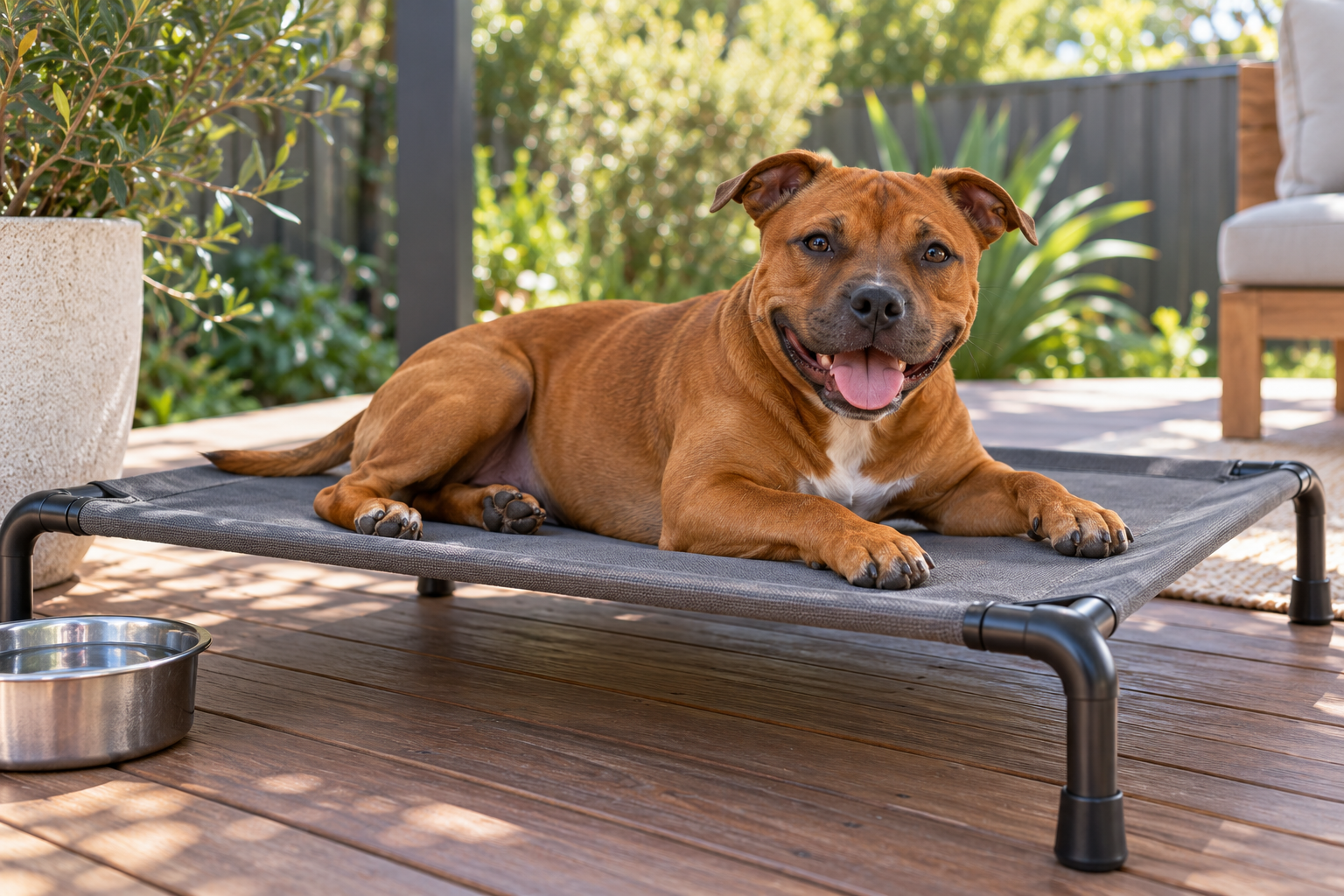
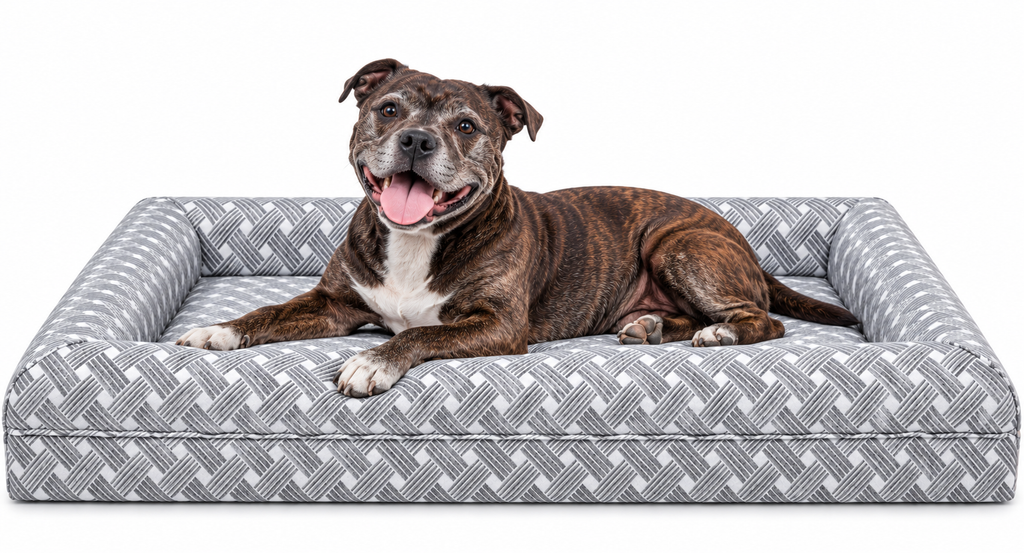
A washable bolster bed is the sensible budget option for a young, healthy Staffy, or as a second bed in another room. The raised edge gives a dog somewhere to rest its head and something to lean against, which suits dogs that curl up. The fill is usually polyester fibre, so expect it to flatten over time. That is the trade-off for the price.
What matters most here is washing. RSPCA Australia advises using washable bedding and cleaning it regularly, and a cheap bed that goes in the machine whole, or has a zip-off cover, stays usable far longer than one you can only sponge down. Check the inner sleeping area, not the outside measurement, because thick bolsters take up a lot of room. It is easy to buy a washable bolster dog bed that looks big enough in the photo and is too small once your dog lies in it.
Look for: fully machine-washable or a zip-off cover; measure the inner area
Good for
Not ideal for
Pick 4 · Older Staffies
Best for older Staffies: thick orthopaedic bed with a low entry
Thick support with an easy step on.
For an older or stiff Staffy, choose the thickest, most supportive foam bed you can find that still has a low, easy step on. Canine Arthritis Management, a vet-led arthritis resource, recommends supportive bedding such as memory foam for dogs with arthritis, placed in a warm, draught-free part of the house with non-slip flooring under and around it.
It is worth being honest about the evidence. The best-known study of a therapeutic dog mattress, run at the University of Pennsylvania, found that owners reported less pain and stiffness after four weeks. But it was a pilot study of 40 dogs, all over about 32 kg, with no control group, and it was funded by the mattress manufacturer. So a good bed can make a sore dog more comfortable. It does not treat arthritis and it does not replace a vet’s pain management plan.
Staffies do seem prone to stiffness. A Royal Veterinary College study of UK vet records found they were 1.8 times as likely as other dogs to be recorded with it. When comparing beds, a thick orthopaedic dog bed for older dogs should have a non-slip base, at least one low or open side, and a washable cover with a waterproof liner in case of accidents. Our guide to Staffy health problems covers joints in more detail.
Look for: thick foam, a non-slip base, a low or open side and a waterproof liner
Good for
Not ideal for
Pick 5 · Crates and puppies
Best for crates and puppies: washable crate mat
Cheap, flat and quick to wash.
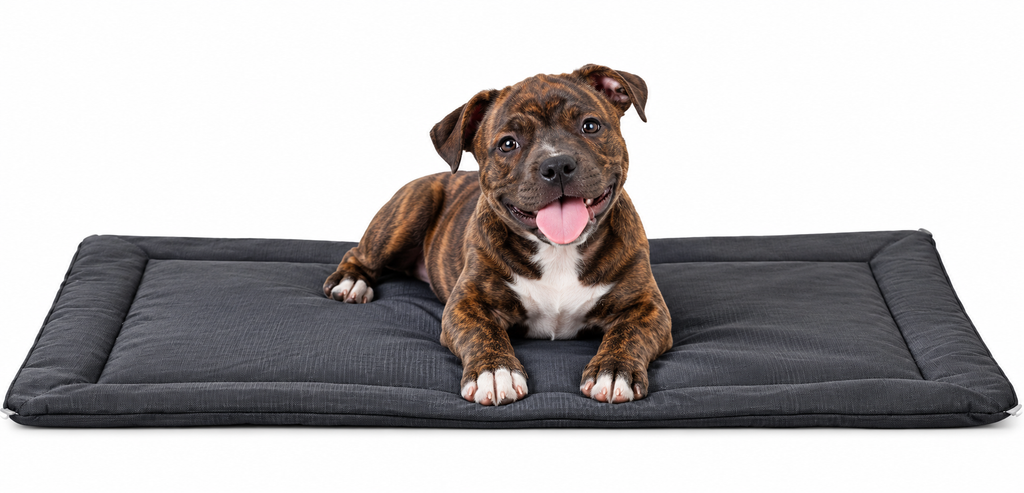
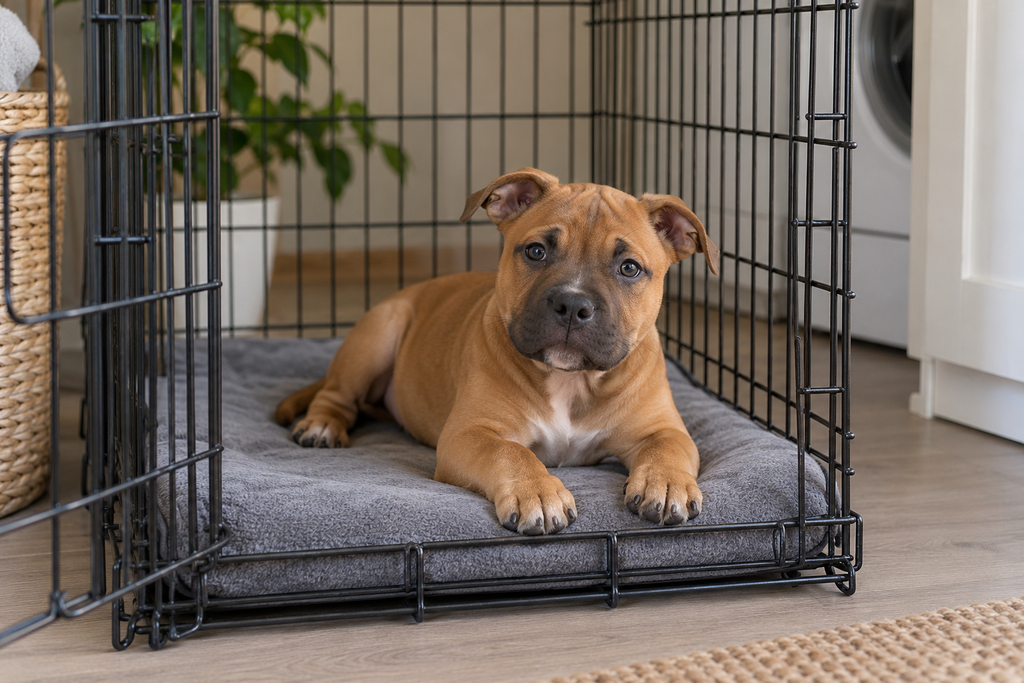
For a crate, or for a puppy, buy a flat washable mat sized to the crate floor, not a full bed. Puppies have accidents and chew, so the bed needs to be cheap, quick to wash and quick to dry. A mat that fits the floor edge to edge also leaves no gaps to dig at. Crate beds are not only for puppies: Guinness is three and still has a bed in his cubby.
Safety matters most at this age. Destructive chewing can end in a gut blockage, and the Merck Veterinary Manual notes that young, large-breed dogs are the most likely to have an obstruction caused by eating a foreign object. If your puppy is tearing pieces off a mat, take it away and ask your vet or trainer what to use instead. Choose a washable crate mat with no zips, buttons or loose piping within reach, and measure the inside of the crate before ordering. Our Staffy puppy training guide covers crate training itself.
Look for: a mat sized to the crate floor, with no zips, buttons or loose piping
Good for
Not ideal for
Still not sure which bed?
Start with a solid foam bed with a washable cover, measured to your dog. Add a raised bed later if yours chews or lives outside in summer.
What size bed does a Staffy need?
A Staffy needs a bed long enough to lie flat on its side with legs stretched out, which means buying by measurement and not by the label. Sizes are not standardised, so one brand’s Medium is another brand’s Large.
To measure your Staffy for a bed:
That margin is a common rule of thumb, not a veterinary standard, so go larger if your dog sprawls. For bolster beds, check the internal dimensions. If you are buying for a puppy, look up the likely adult size on our Staffy weight chart before spending much. A cheap mat now and a proper bed later usually makes more sense than buying big and hoping.
Weight matters as well as length. Staffies are heavy for their height, and Guinness, at 28 kg, is at the big end for the breed. Check the weight rating on raised beds, and choose thicker foam for heavier dogs.
How to choose a dog bed for a Staffy
Choose on four things: support, a washable cover, how your dog treats bedding, and where the bed will live.
Support
Solid foam supports better than loose fill because it cannot shift away from under the dog. There is no agreed veterinary standard for foam density or thickness in dog beds, so treat numbers on product listings as marketing unless the maker explains them.
Cover and washability
A fully removable, machine-washable cover matters more for Staffies than for many breeds, because they are prone to skin allergies. The same Royal Veterinary College study found Staffies were 1.9 times as likely as other dogs to be diagnosed with atopic dermatitis. For dogs with a diagnosed house dust mite allergy, veterinary allergy advice is to wash bedding weekly at 60°C, so check that the care label allows a hot wash. Our guides to Staffy skin problems and the best dog food for sensitive skin cover the rest of the picture.
Chew resistance
No fabric bed is chew-proof. “Chew-resistant” usually means a tougher weave, hidden zips and reinforced seams, which slows a dog down but does not stop one.
Where the bed lives
Match the bed to the spot. A Staffy’s coat is short and close, so it gives less insulation than a thick double coat. Indoors, keep the bed out of draughts and off cold tiles in winter. RSPCA Australia says dogs should be allowed to sleep inside where that is possible and safe. If a dog does sleep outside, the kennel should be warm, dry, draught-free and raised off the ground, with washable bedding. In summer, shade and airflow matter more than padding.
Guinness is an indoor dog at bedtime, and in winter he is usually found in front of the heater. For cold nights, our Staffy clothing guide covers coats and jumpers.
How to stop a Staffy destroying their bed
Bed destruction is usually a behaviour problem, not a product problem. VCA Animal Hospitals describes destructive chewing as often a sign of an anxious or bored dog, or of a natural urge to gnaw that is not being met.
What helps:
Swallowed bedding is the real risk. Cornell University’s canine health centre lists toys and pieces of clothing among the objects dogs commonly swallow, and vomiting, loss of appetite, abdominal pain and lethargy among the signs of a blockage, which is an emergency that often needs surgery. If you think your dog has eaten part of a bed, call your vet straight away. For puppies, our puppy biting guide explains how to redirect chewing.
Looking after the bed
Wash the cover regularly and replace the bed when it stops supporting your dog. There is no official washing schedule: RSPCA Australia simply says bedding should be cleaned regularly. Every week or two is a reasonable routine for most dogs, and weekly at 60°C if your vet has diagnosed a dust mite allergy.
A simple routine:
Frequently asked questions
Bottom line
For most adult Staffies, buy a solid foam bed with a zip-off washable cover, sized by measuring your dog stretched out. Start chewers on a raised frame bed, give older dogs thicker foam with a low entry, and keep puppies on a cheap washable mat until they have grown.
For the rest of the kit, see our guides to the best harness for a Staffy and Staffy clothing.