Staffy Puppy Training
Staffy Puppy Training: The Complete Guide
If you’ve just brought a Staffy puppy home, you’ve probably already had someone tell you they’re “hard to train” or “a bit much.” Ignore that. Staffies are actually one of the more biddable, food-motivated, people-focused breeds you can own — most of what gets mislabelled as stubbornness is over-excitement, and most of what gets mislabelled as aggression is a puppy that was never taught bite control. Both are entirely fixable with the right approach, started early.
This guide covers everything from the day you bring your puppy home through to solid basic obedience: when to start, how to socialise safely, what to do about biting and nipping, crate and house training, core commands, and the mistakes that cause the most problems down the track. I’m working through all of this with Guinness’s early puppyhood as the reference point — some of it went smoothly, some of it didn’t, and I’ll be upfront about which was which.
When to Start Training a Staffy Puppy
Start the day your puppy comes home — usually around eight weeks old. You’re not teaching formal obedience yet, but every interaction from day one is training whether you mean it to be or not: what gets rewarded, what gets ignored, what your puppy learns is safe.
The one piece of timing that trips owners up is the overlap between the socialisation window and the vaccination schedule. Puppies are typically home at 8 weeks, with a second vaccination round around 10–12 weeks and a third at 16–18 weeks before they’re considered fully protected. The trouble is the critical socialisation period — when a puppy’s brain is most open to forming lasting, positive associations with new people, animals, and environments — runs from roughly 3 to 16–17 weeks. Wait until full vaccination to start socialising and you’ve missed most of the window that matters.
While you’re getting started, it’s worth checking your puppy’s growth is on track too – see our Staffy weight chart by age.
The RSPCA’s guidance here is the one to follow: you can start socialising safely before full vaccination by carrying your puppy in unfamiliar places rather than letting them walk where unvaccinated dogs may have been, hosting controlled visits from healthy, fully vaccinated dogs and calm people, and exposing them to sounds, surfaces, and situations at home. Puppy preschool classes — usually run through vet clinics — are designed around exactly this trade-off and are worth booking before your puppy is even home.
Understanding the Staffy Temperament (And Why “Stubborn” Is the Wrong Word)
Staffies were bred as companion dogs, not working dogs bred to operate independently of their handler — which is part of why they’re generally so responsive to people. The “nanny dog” reputation is genuine: they’re typically affectionate, tactile, and eager for approval. What owners often read as defiance is usually one of two things: a puppy that’s too aroused to think clearly, or a puppy that hasn’t been shown what you actually want yet.
That distinction matters because it changes how you respond. A dog that’s “being stubborn” gets met with more pressure. A dog that’s overexcited or confused gets met with a calmer environment, a clearer cue, and a better reward. The second approach is the one that actually works with this breed, and it’s the one every method in this guide is built around.
It’s also worth being honest about the other side of the temperament: Staffies can be dog-selective, and this shows up in some individuals regardless of how well they were raised, alongside cases that are genuinely down to under-socialisation. Neither the “aggressive breed” stereotype nor the “it’s all in how you raise them” line is fully accurate. Good socialisation and bite work in puppyhood meaningfully reduce the odds of problems later, but they don’t guarantee every adult Staffy will be dog-social — and that’s a normal, manageable trait to plan around rather than a training failure if it turns up.
Socialisation: The Single Most Important Thing You’ll Do
If you only take one section of this guide seriously, make it this one. Behavioural euthanasia — not disease — is the leading cause of death in dogs under three, and the large majority of preventable behavioural problems trace back to a poor socialisation period.
Socialisation isn’t just “meeting other dogs.” It means exposing your puppy to a wide range of sights, sounds, surfaces, people, and situations, in a way that stays positive throughout. A few principles that matter more than the checklist itself:
Bite Inhibition and Nipping
Every Staffy puppy will bite and nip. It’s normal, it’s not aggression, and it’s not something you can skip past — but it is something you need to actively teach your way through, because an adult Staffy’s jaw is considerably more powerful than a puppy’s.
Puppies normally learn bite pressure control from littermates: bite too hard during play and the other puppy yelps and stops playing. You’re now standing in for that feedback loop. The method that behaviourists including Dr. Ian Dunbar — whose bite inhibition work is the standard most modern puppy training is built on — recommend is straightforward:
- The moment your puppy’s teeth touch skin, give a short, sharp “ow” and stop all interaction for 20–30 seconds.
- Don’t yank your hand away — sudden movement often triggers a chase-and-grab reflex, which makes things worse.
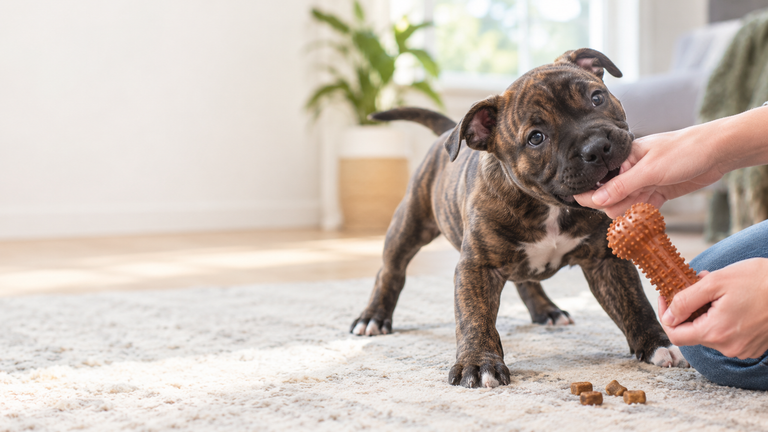
- Redirect to an appropriate chew toy every time, rather than only after a bite occurs. A bundle that covers the different chewing stages is worth having on hand from day one – we like the Nylabone Puppy Toy Bundle because it covers you from early teething through to when the adult teeth come in, rather than needing to keep replacing a single toy every few weeks.
- If nipping escalates when your puppy is overtired or overexcited, it’s a management problem more than a training one — a short time-out in a calm space (not as punishment, just as a reset) usually settles it faster than continued correction attempts.
- Be consistent across the household. If one person allows rough hand play and another doesn’t, your puppy gets mixed signals and the behaviour takes longer to resolve.
What doesn’t work well: shouting, physically restraining the muzzle, or “alpha rolling.” These tend to either escalate the behaviour through fear or teach a puppy to avoid the correction rather than the biting itself — outdated advice you’ll still see on some breed forums, but not what current force-free trainers or vet behaviourists recommend. For the full step-by-step method, and a realistic answer to when Staffy puppies stop biting, see the Staffy puppy biting guide.

Crate and House Training
Crate training gives your puppy a safe space of their own and makes house training dramatically faster — dogs instinctively avoid soiling where they sleep, so a properly sized crate (big enough to stand, turn, and lie down, not much bigger) becomes a genuinely useful tool rather than confinement for its own sake. By one with a divider panel rather than sizing for your puppy today – a crate like this one lets you shrink the space while they’re small and open it back up as they grow, so you’re not buying twice.
Start young, keep the crate a strictly positive place — feed meals in there, add favourite chew toys, never use it as a punishment space — and build up duration gradually. For house training itself: take your puppy out immediately after waking, after eating, and after play, reward the instant they go in the right spot, and expect accidents as a normal part of the process rather than a sign anything’s going wrong.

Core Obedience Commands
Once bite inhibition and basic house manners are underway, layer in formal commands. Keep every session short — five to ten minutes for a young puppy — and end on a success rather than pushing until they lose focus.
Sit and stay: the foundation for almost everything else, including calmer greetings and safer road crossings later on.
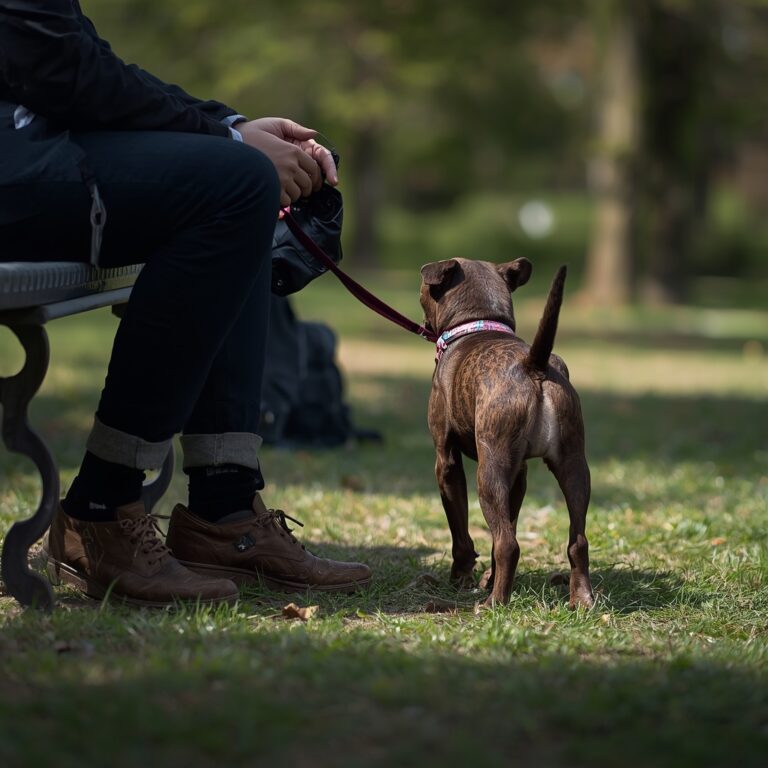
Loose-lead walking: Staffies are strong for their size, so leash manners are worth prioritising before pulling becomes a habit built on months of practice. The strength comes from a genuinely broad chest and powerful shoulders across the body instead of the neck, reducing the risk of tracheal strain. A front-clip no-pull harness paired with a padded rope leash built for strong pullers is a solid, no-fuss combination while you’re working on this. Reward for walking near you rather than only correcting for pulling — the goal is to make staying close more rewarding than forging ahead.
Lead-training a Staffy who pulls is much easier with the right gear – our guide to escape proof harnesses covers what actually holds up to a determined Staffy.
Recall: arguably the highest-value command you’ll teach, and worth its own dedicated training block. Start in a low-distraction space like your backyard before testing it anywhere with real distance or distractions.
Treats used during training count toward your staffy’s daily intake – check our feeding chart by weight and age so training treats don’t timp them into overeweight.

Managing Energy: Physical and Mental Stimulation
A bored Staffy is where most “behaviour problems” actually start. They’re a moderate-to-high energy breed that also needs mental work — puzzle feeders, scent games, and short training sessions tire a puppy out. A treat-dispensing puzzle feeder is an easy one to start with – ours has multiple difficulty levels, so it stays useful as your puppy gets better at solving it, rather than being mastered and abandoned in a week. Balance the two: enough physical exercise to settle the body, enough mental work to settle the mind, with rest genuinely built in — puppies need a surprising amount of sleep, and an overtired puppy is often the one that seems “naughtiest.”
Common Mistakes Staffy Owners Make
When to Get Professional Help
Most puppy behaviour resolves with consistent, patient handling. It’s worth booking a certified trainer or vet behaviourist if you’re seeing genuine aggression (not play-biting) toward people, resource guarding that isn’t improving, reactivity toward other dogs that’s getting worse rather than better, or if you simply feel stuck — a few sessions early is far easier than untangling an established pattern later. Ask specifically whether they use force-free, reward-based methods; that’s the current standard of care, not an optional preference.