Staffy vs Amstaff: What’s the Difference?
Staffy vs Amstaff: What’s the Difference?
Quick answer
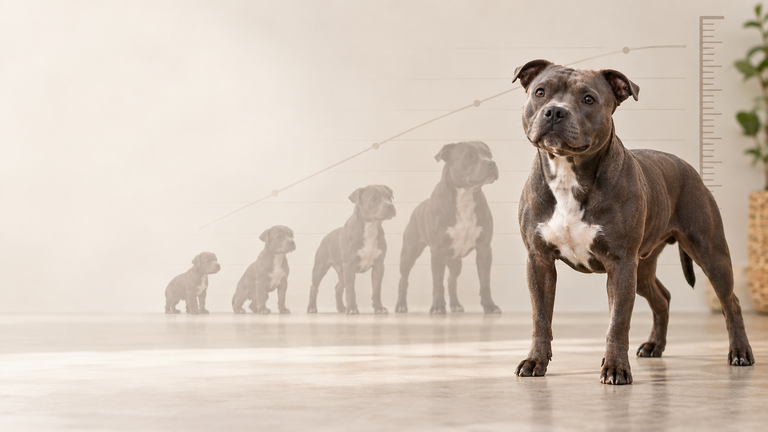
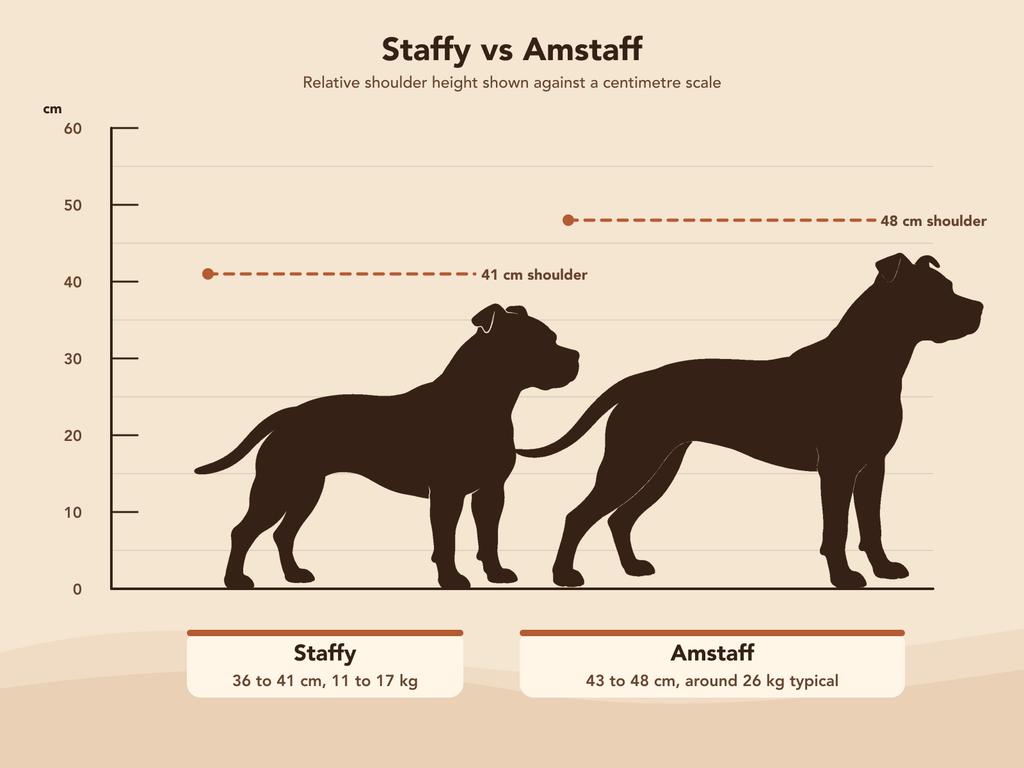
The Staffy (Staffordshire Bull Terrier) and the Amstaff (American Staffordshire Terrier) are two separate breeds that share the same bull-and-terrier ancestry. The clearest difference is size: a Staffy stands 36 to 41 cm at the shoulder and weighs 11 to 17 kg, while an Amstaff stands 43 to 48 cm and is considerably heavier. Each has its own breed standard, and the two are registered separately.
In Australia the two get lumped together constantly. People say “English Staffy” and “American Staffy” as if they were two sizes of the same dog, and plenty of rescue listings just say “Staffy” for anything broad-headed and muscular.
They’re related, but they aren’t the same breed. This guide sets out what separates them, using the breed standards and breed club sources. It goes deeper than the summary in the types of Staffy guide.
Are the Staffy and the Amstaff the same breed?
No. They are separate breeds with separate breed standards, although they come from the same stock. Both descend from the bull-and-terrier dogs bred in 19th-century England by crossing Bulldogs with terriers.
According to the Staffordshire Terrier Club of America, these dogs began arriving in America as early as 1870, where breeders developed a heavier type than the English dogs. The American Kennel Club accepted them in 1936 as Staffordshire Terriers, and the name was changed to American Staffordshire Terrier on 1 January 1972 to mark them out as a different breed from the Staffordshire Bull Terrier.
So the Amstaff isn’t a big Staffy, and the Staffy isn’t a small Amstaff. They’ve been bred to different standards for the best part of a century.
Staffy vs Amstaff at a glance
The main differences, taken from the breed standards and breed club sources:
|
Feature |
Staffy (Staffordshire Bull Terrier) |
Amstaff (American Staffordshire Terrier) |
|---|---|---|
|
Height at shoulder |
36 to 41 cm |
Dogs 46 to 48 cm, bitches 43 to 46 cm |
|
Weight |
Dogs 13 to 17 kg, bitches 11 to 15.4 kg |
Not set in the standard; around 26 kg is typical |
|
Accepted colours |
Red, fawn, white, black, blue or brindle, with or without white |
Any colour; mostly white, black and tan, and liver are discouraged |
|
Ears |
Rose or half-pricked |
Rose or half-pricked in the Australian standard |
|
Lifespan |
Over 12 years |
12 to 14 years |
|
Registered by |
Royal Kennel Club (UK), Dogs Australia, AKC |
Dogs Australia, AKC. Not on the Royal Kennel Club’s breed list |
|
Breed club health tests |
L-2-HGA and hereditary cataract DNA tests, eye testing |
Hips, heart, thyroid, cerebellar ataxia DNA test |
How big is an Amstaff compared with a Staffy?
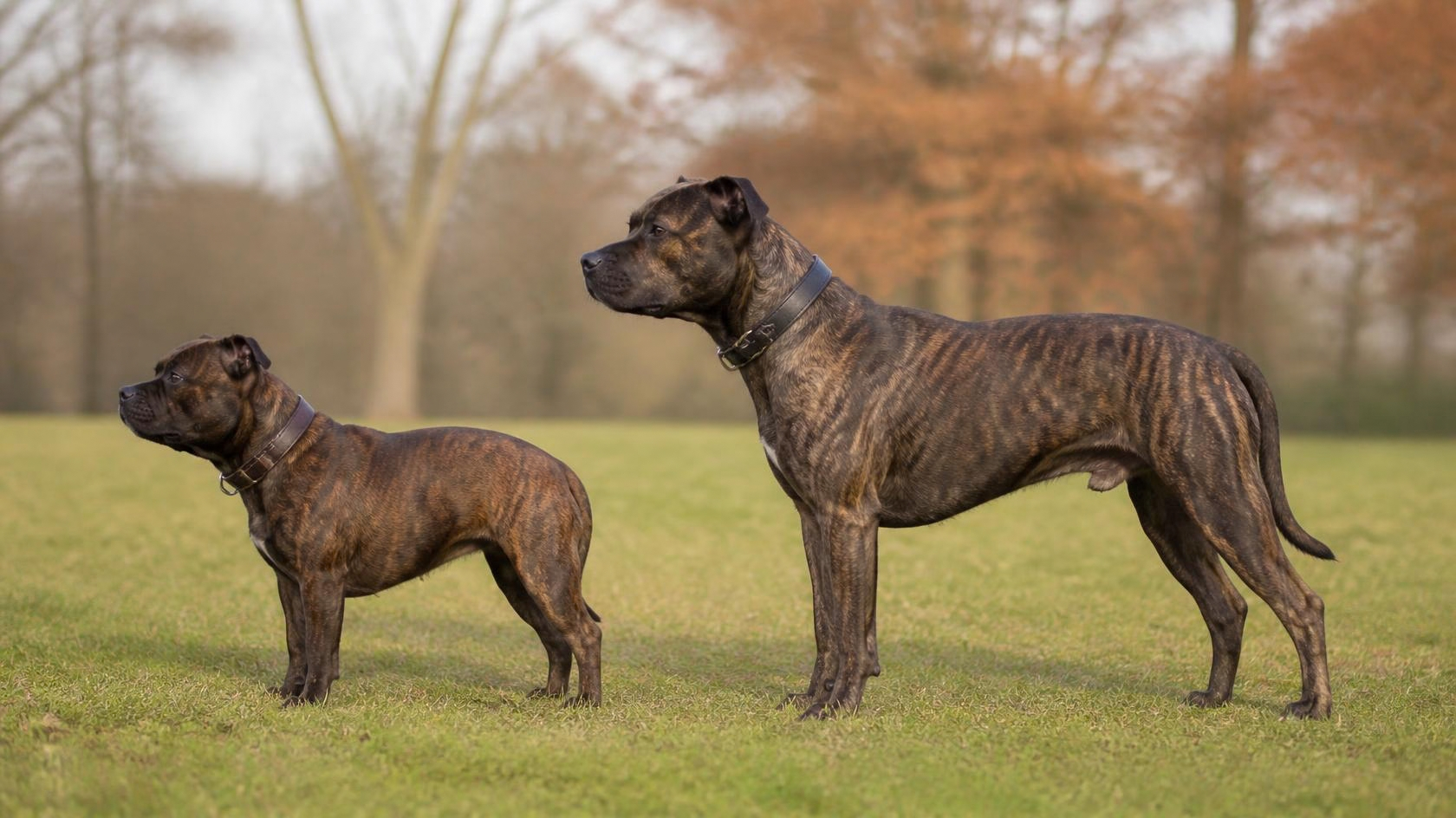
An Amstaff is noticeably bigger: roughly 5 to 10 cm taller at the shoulder and often 10 kg or more heavier. The Royal Kennel Club standard puts the Staffy at 36 to 41 cm, with dogs at 13 to 17 kg and bitches at 11 to 15.4 kg.
The American Kennel Club standard for the Amstaff gives 18 to 19 inches (about 46 to 48 cm) for dogs and 17 to 18 inches (43 to 46 cm) for bitches. It doesn’t set a weight, saying only that height and weight should be in proportion. VCA Animal Hospitals lists a typical weight of 57 lb, which is about 26 kg.
That gap matters day to day: a bigger, stronger dog on the lead, more food and usually more room needed. If you’re trying to work out whether your own dog is in the Staffy range, the Staffy weight chart shows healthy weights by age.
How do you tell a Staffy from an Amstaff by looking?
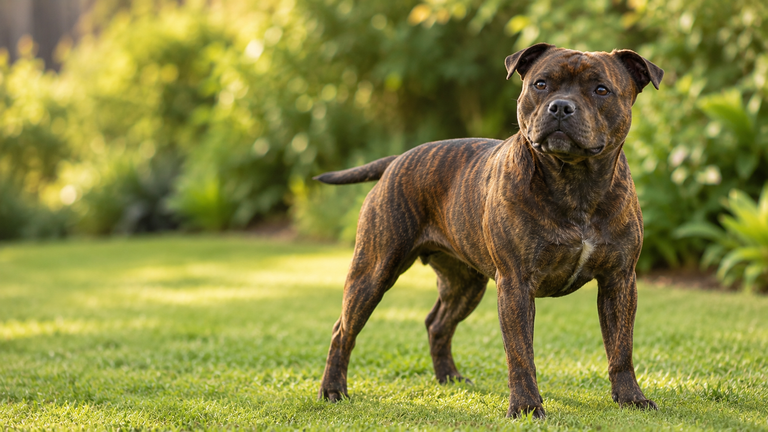
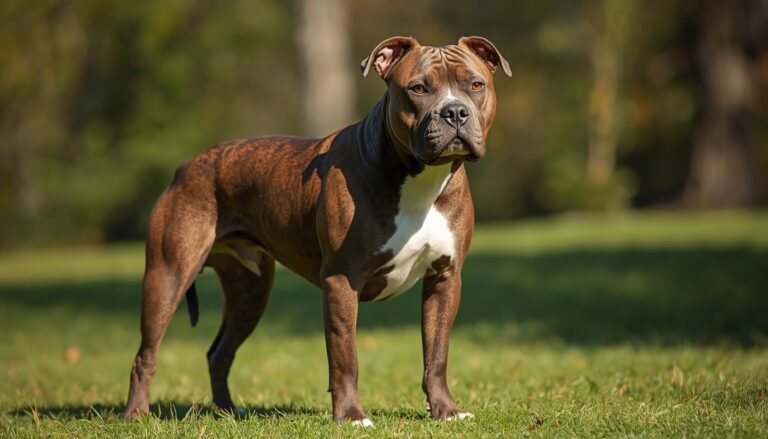
Height and leg length are the most reliable visual clues. A Staffy is compact and low to the ground for its width, while an Amstaff is taller and longer in the leg, with a more athletic outline.
Other things to look at:
Looks only go so far. Crossbreeds between the two are common, and many dogs called Staffies in shelters are mixes. If it matters, pedigree papers or a DNA test are the only firm answer.
If you have a rescue or a dog without papers and want an answer, an at-home kit such as the Embark Breed & Health Dog DNA Test is the practical route. It is a cheek swab you post back, with results generally arriving in two to four weeks. Embark says it identifies 400+ breeds, types and varieties, so a mixed-breed dog gets a percentage breakdown instead of a single label, and it screens for 270+ genetic health risks at the same time.
Two caveats. Staffies and Amstaffs share a lot of ancestry, so treat a result as strong evidence, not a pedigree: it will not get a dog registered as either breed. And a health risk flag is something to take to your vet, not a diagnosis.
Affiliate link: as an Amazon Associate, Staffy World earns from qualifying purchases at no extra cost to you.
Do they differ in temperament and exercise needs?
The two breeds are described in similar terms: people-focused, loyal and playful. The Royal Kennel Club suggests up to an hour of exercise a day for a Staffy. VCA describes the Amstaff as needing daily exercise such as a long walk, a short jog or energetic games, and as generally good with children but not always friendly towards unfamiliar dogs.
Individual dogs vary more than breed descriptions suggest, and upbringing counts for a lot. With either breed, early socialisation and consistent training matter, and the bigger the dog, the more they matter. The Staffy puppy training guide covers the foundations, and most of it applies equally to an Amstaff.
Do Staffies and Amstaffs have different health problems?
Each breed has its own list of recommended health tests. For Staffies, the Royal Kennel Club recommends DNA tests for L-2-HGA and hereditary cataract, plus eye testing. For Amstaffs, the Staffordshire Terrier Club of America recommends hip, heart and thyroid evaluations and a DNA test for a form of cerebellar ataxia known as NCL-A.
Whichever breed you’re looking at, ask the breeder for the parents’ results for that breed’s tests. The Staffy health problems guide explains the Staffy ones in plain terms. I’m not a vet, so for anything about an individual dog’s health, speak to yours.
Are Amstaffs or Staffies restricted breeds?
In Victoria, neither is. The Victorian government states that American Staffordshire Terriers are not restricted breed dogs. The restricted breeds there are the American Pit Bull Terrier (or Pit Bull Terrier), Perro de Presa Canario, Dogo Argentino, Japanese Tosa and Fila Brasileiro.
Because Amstaffs and pit bulls look alike, owners in Victoria can show that a dog is an Amstaff with a veterinary certificate or a pedigree certificate from the Australian National Kennel Council or one of its member bodies. Rules differ between states and councils, so check with your own council before you buy or adopt.
In the UK, the banned types include the Pit Bull Terrier, and the government is clear that whether a dog is a banned type depends on what it looks like, not its breed or name. The Staffordshire Bull Terrier isn’t on the banned list. The Amstaff isn’t on the Royal Kennel Club’s list of recognised breeds, and a dog that matches many pit bull characteristics could be assessed as a banned type whatever it’s called.
This is general information, not legal advice. Laws change, so confirm the current rules where you live.
What do “American Staffy” and “English Staffy” mean?
They’re everyday Australian names for these two breeds. “American Staffy” means the American Staffordshire Terrier, and “English Staffy” means the Staffordshire Bull Terrier. Neither is an official breed name, and no kennel club registers an “English Staffy” as a separate type.
Other bull breeds get pulled into the same conversation. The American Pit Bull Terrier and the American Bully are different breeds again, and the types of Staffy guide explains how they all relate.
Which breed suits you: Staffy or Amstaff?
If you want a smaller dog that’s easier to lift, house and handle, the Staffy is the more manageable of the two. If you want a larger, more athletic dog and have the space and strength for one, the Amstaff may suit.
Things worth weighing up before you choose: