Best Harnesses for Staffies
Best Harnesses for Staffordshire Bull Terriers
Guinness has backed out of two harnesses in his life. Both were marketed as “secure fit.” Here’s what we learned, and what we’d actually buy again.
Affiliate disclosure: Some links on this page are Amazon affiliate links. If you buy through them I may earn a small commission at no extra cost to you. It never changes what I recommend. As an Amazon Associate I earn from qualifying purchases. Full disclosure.
If you own a Staffy and you’re shopping for a harness, you’ve probably already noticed the problem nobody puts on the product listing: a lot of dogs marketed as “medium” or “large” build for harness sizing charts don’t have a Staffy’s proportions. Staffies carry a broad, barrel-shaped chest on top of a neck that’s often thicker than their head. That combination — wide chest, narrow head, thick neck — is exactly the shape that lets a dog back out of a badly designed harness by ducking and pulling backward. It’s not disobedience or a “bad” dog. It’s basic anatomy meeting a harness that wasn’t built with that shape in mind.
This isn’t a hypothetical. It’s one of the most common complaints in Staffy owner communities, and it’s backed up by what buyers of general-purpose harnesses report when their dog has an athletic, deep-chested build — the fit gaps at the shoulders and armpits, and a determined dog finds them fast.
Why Standard Harnesses Fail on a Staffy
Most budget and mid-range harnesses are sized off a single chest measurement, with the assumption that neck and chest proportions scale together in a fairly standard ratio. Staffies break that assumption. A harness sized correctly for a Staffy’s chest is often loose enough around the neck and shoulders for the dog to walk backward out of it, especially if they’re startled, spot another dog, or are still learning loose-lead walking. This is also why we’ve paired this guide with our Loose-Lead Walking Guide — a harness that fits well makes training easier, but no harness fixes a dog that’s never been taught not to bolt.
What to Look For in an Escape-Proof Harness
None of these features alone guarantee a harness is escape-proof — fit trumps features every time, which is why we’d always recommend measuring your dog properly (chest girth at the widest point, behind the front legs) rather than buying by weight range alone.
Harnesses Worth Considering
Every pick below says who it suits and what to check before you buy. The buttons go to Amazon. I may earn a commission if you buy, at no extra cost to you.
Pick 1 · Multi-point fit
Kurgo Tru-Fit Smart Harness
Five adjustment points and a chest plate that takes the pull off the throat.
Five-point adjustment and a chest plate designed to spread pulling force across the sternum rather than the throat. Doubles as a car safety harness if you want one product for both jobs.
Adjustment points: five · Bonus: doubles as a car safety harness
Why you’ll like it
Know before you buy: no harness is escape-proof on its own. Measure chest girth just behind the front legs and check it against the brand’s size chart, not your dog’s weight.
Pick 2 · Escape-resistant step-in
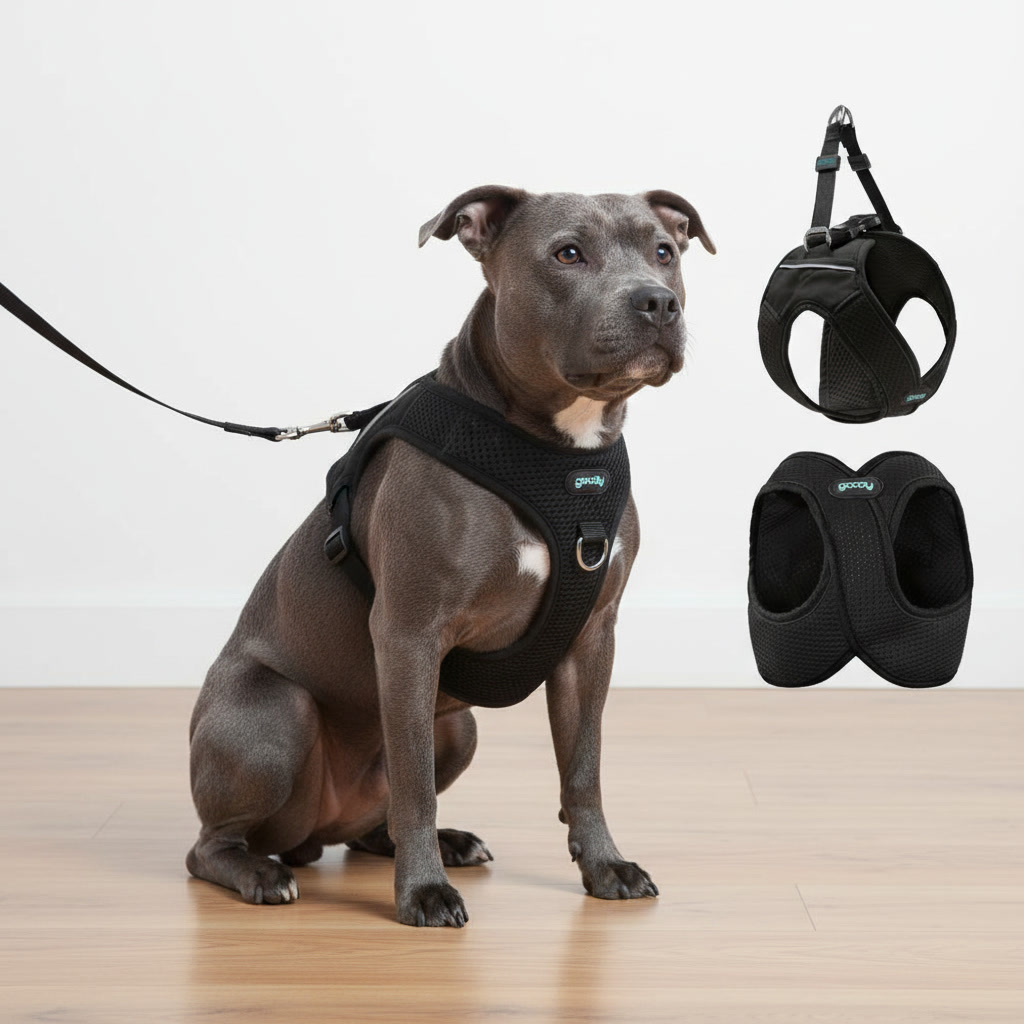
Gooby Escape-Free / Step-In Escape-Proof Harness
Built around the escape problem, with a snug fit through the shoulders.
Purpose-built around the escape problem specifically, with a snugger fit through the shoulders than most step-in designs. Worth checking their sizing chart carefully against a Staffy’s chest-to-neck ratio rather than weight alone.
Style: step-in · Size by: chest and neck, not weight
Why you’ll like it
Skip it if
Know before you buy: no harness is escape-proof on its own. Measure chest girth just behind the front legs and check it against the brand’s size chart, not your dog’s weight.
Pick 3 · Front clip, heavy duty
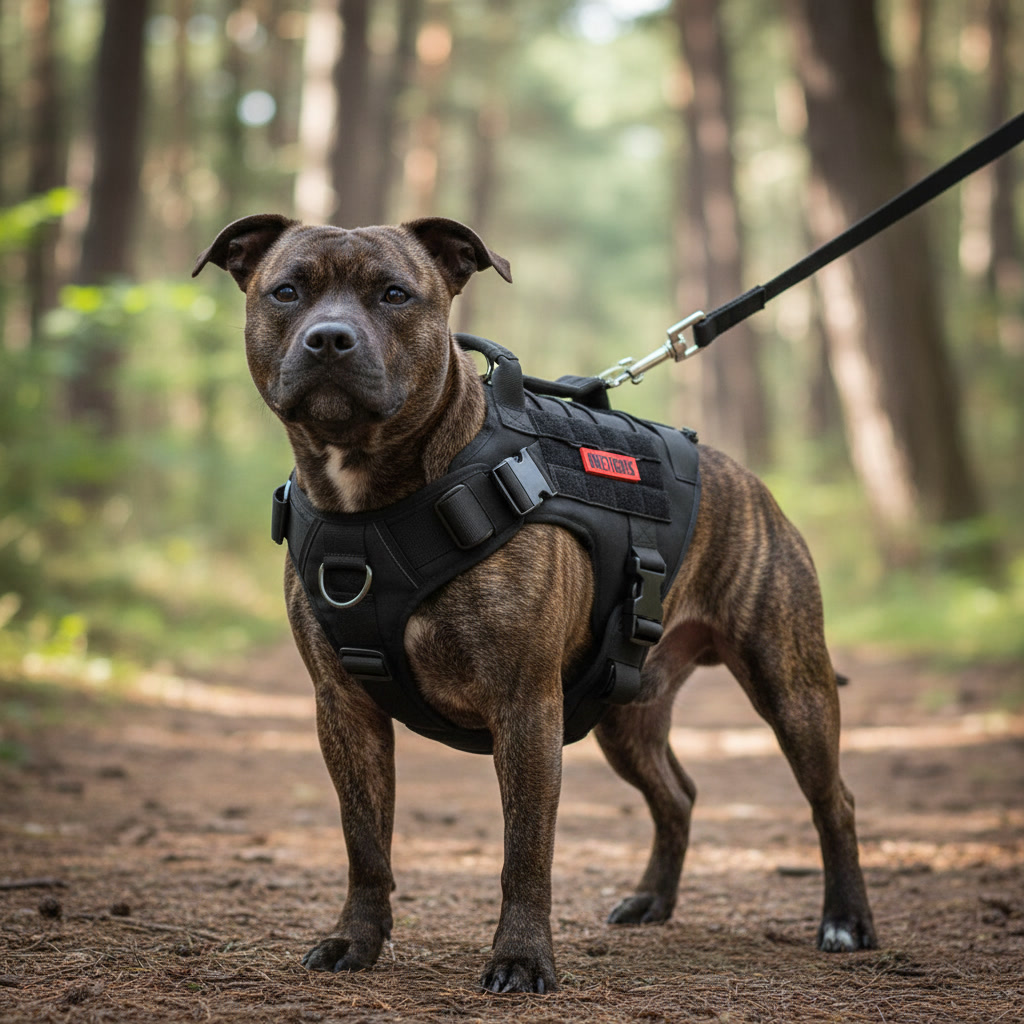
OneTigris Tactical Front-Clip Harness
A heavier build with a front clip that discourages pulling.
Heavier-duty build with a front leash attachment point, which also doubles as a light no-pull aid since front-clip attachments turn a dog slightly off-balance when they pull. Popular with owners of strong, muscular breeds for the reinforced stitching.
Lead clip: front · Build: reinforced stitching
Why you’ll like it
Know before you buy: a front clip makes pulling less rewarding, but it is not training on its own. Measure chest girth and check the size chart before you order.
Not sure which one?
Measure your Staffy’s chest girth first, then choose the harness whose size chart fits that number. If you want one harness that does the most, start with the Kurgo.
How to Fit a Harness Properly (So It Actually Works)
- Measure chest girth at the widest point, just behind the front legs — not the neck, and not by weight guess.
- Check the manufacturer’s sizing chart against that measurement, not the “breed size” label — Staffy-specific sizing doesn’t exist on most listings.
- Once fitted, do the “two-finger test” at the girth strap and neck opening: you should fit two fingers flat, not a whole hand.
- Test it under supervision before a real walk — walk your dog on lead in the yard or hallway first and watch for any gapping at the shoulders when they pull backward.
- Recheck fit every few months, especially with a young or still-filling-out dog — Staffies can change shape noticeably between 1–3 years old.
Once it’s fitted properly, a good harness makes lead training much easier – see our Staffy puppy training guide for how to introduce it.