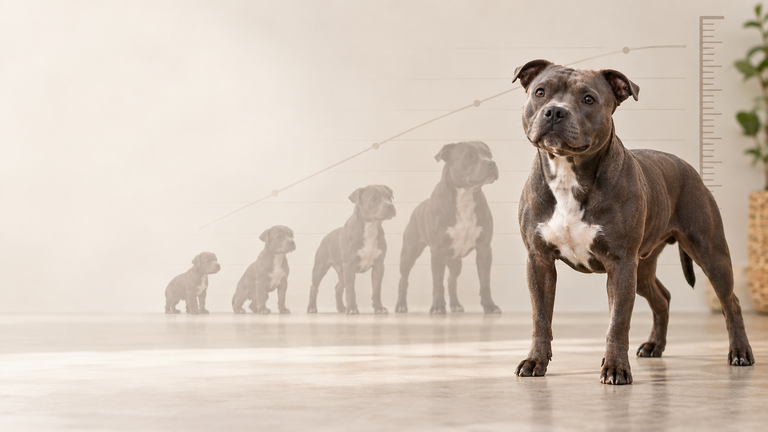
Types of Staffy
Types of Staffies: Colours, Sizes and the Breeds People Confuse Them With
Quick answer
There is only one Staffordshire Bull Terrier — the UK Kennel Club, the FCI and the American Kennel Club all recognise it as a single breed with one size standard. When people search “types of staffy,” they’re almost always asking about one of four different things: coat colour, a mix-up with a similar-looking breed (usually the American Staffordshire Terrier), an unrecognised size marketing term (“mini” or “pocket” Staffy), or the older English vs American naming confusion. This guide covers all four, honestly, with sources.
There’s only one Staffordshire Bull Terrier
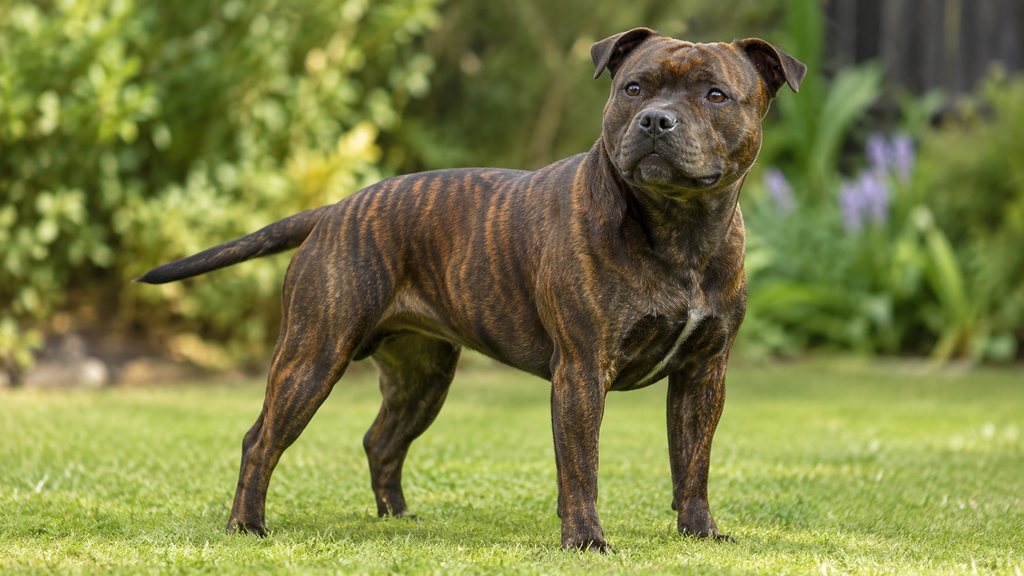
It’s worth saying plainly, because a lot of Staffy content dodges this: the Staffordshire Bull Terrier is one breed with one breed standard. There’s no “English Staffy,” “show type” or “working type” recognised by any kennel club — those are just descriptions people use informally, not separate types.
The UK Kennel Club breed standard sets the benchmarks:
The FCI standard and the AKC standard both align with these figures — a dog outside this range isn’t a “different type,” it’s outside the breed standard, whatever a seller might call it.
The breed was developed in 19th-century Staffordshire and Birmingham from bulldog-and-terrier crosses, originally for the blood sports of the era. The Kennel Club recognised it in 1935 after Joseph Dunn’s campaigning; the AKC followed in 1974 as its 121st registered breed. A 2017 genome study traced the wider bull-and-terrier lineage back to Irish terrier stock from the 1860s–70s — so today’s Staffy, Amstaff, Bull Terrier and American Pit Bull Terrier are all cousins from the same 19th-century root, which is exactly why people keep asking whether they’re “types” of one another. They’re not — they’ve been separate, independently bred breeds for well over a century.
“Types” by colour
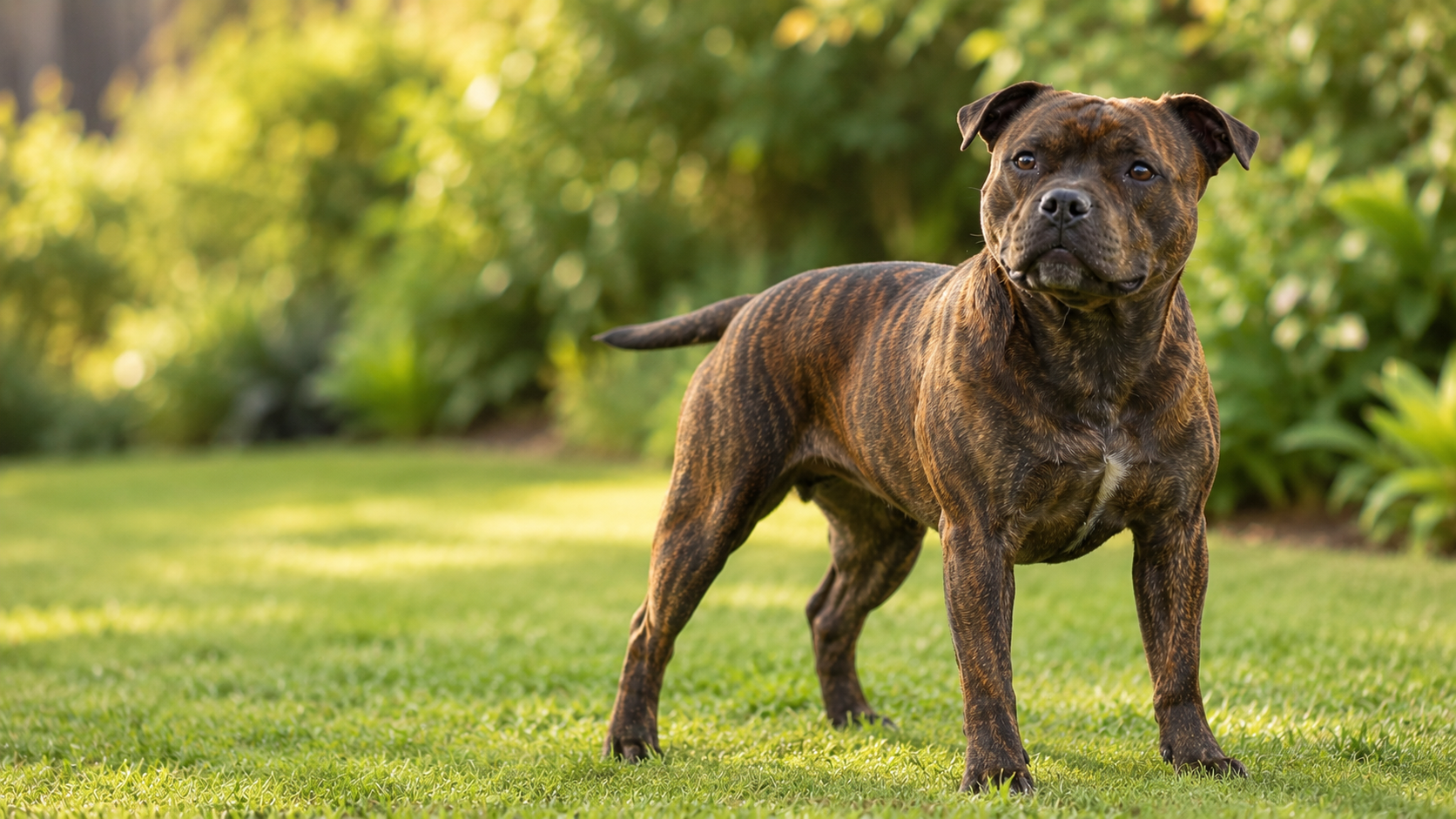
The most common reason people land on “types of staffy” is coat colour — they’ve seen a fawn Staffy and a brindle Staffy and assumed they’re looking at different varieties. They’re not; colour is a coat trait, not a type, and all of the following sit within the one breed standard above:
For the full picture, see our complete guide to every recognised Staffy colour.
One honest note worth flagging here rather than burying: blue-coloured dogs across many breeds, Staffies included, carry a higher reported rate of colour dilution alopecia, a coat and skin condition linked to the dilution gene itself. It doesn’t affect every blue dog, and it isn’t a reason to avoid the colour — but a breeder or article that treats blue as purely a rare, desirable extra without mentioning it isn’t giving you the full picture.
English Staffy vs American Staffy (Amstaff) — the real difference
This is the comparison people are actually after most of the time, so here’s the short version now.
|
Staffordshire Bull Terrier |
American Staffordshire Terrier |
|
|---|---|---|
|
Origin |
England, 19th century |
USA, developed from SBT stock imported in the 1800s |
|
Recognised by |
KC (1935), FCI, AKC |
AKC (1936, as “Staffordshire Terrier”; renamed 1972) |
|
Height |
36–41 cm (14–16 in) |
43–48 cm (17–19 in) |
|
Weight |
11–17 kg (24–37 lb) |
18–32 kg (40–70 lb) |
|
Build |
Compact, low-slung, very muscular for its size |
Taller, heavier-boned, more substantial overall |
|
Often confused with |
AmStaff, American Bully |
SBT, American Bully, American Pit Bull Terrier |
In short: an American Staffordshire Terrier is a distinct breed descended from the same 19th-century stock, bred up in size in the United States and recognised separately by the AKC since 1936. It is not a “bigger version” of the Staffy in any official sense — it’s had its own breed standard for close to a century.
Other look-alikes people lump in as “types”
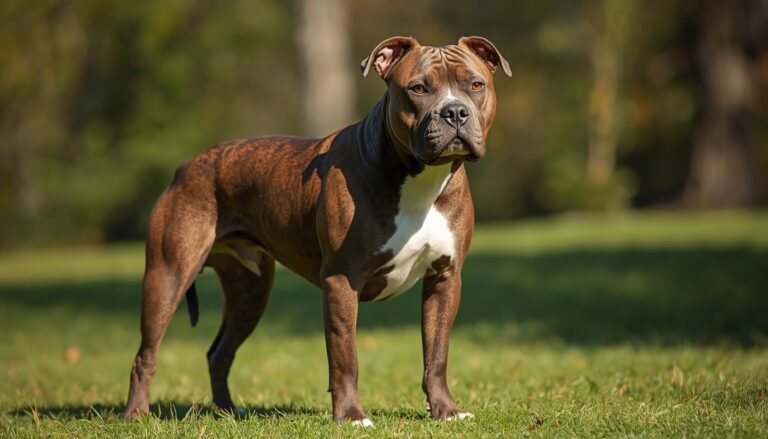
Two more breeds regularly get mistaken for a Staffy “type” — worth naming plainly rather than glossing over:
None of these four breeds — Staffy, Amstaff, American Pit Bull Terrier, American Bully — are interchangeable “types” of each other. They’re four separately recognised (or, in the Bully’s case, breed-club-recognised) breeds that share distant ancestry and a passing resemblance.
“Mini,” “pocket” and “micro” Staffies — not a real type
This one deserves straight talk. “Mini Staffy,” “pocket Staffy” and “micro Staffy” are marketing terms, not recognised sizes or types — no kennel club standard includes them, and the searches behind them (“mini staffordshire bull terrier,” “miniature staffordshire bull terrier”) are people trying to work out if what they’re being sold is legitimate.
What’s usually being advertised under these names is one of a few things: a Staffy that’s genuinely undersized relative to the standard above (sometimes through selective breeding for smallness, sometimes simply a small dog within natural variation), a cross with a smaller breed, or — less charitably — a pup mislabelled to justify a higher price. Reputable veterinary and breed-welfare sources caution that deliberately breeding for extreme smallness in a breed not developed for it carries its own welfare risks, in the same way “teacup” and “micro” marketing does in other breeds. That’s a caution worth passing on, not a personal medical claim — if you’re considering a dog sold under one of these labels, it’s worth asking the breeder directly what standard the parents are bred to and asking a vet to independently assess the pup before committing.
Types of Staffordshire Bull Terrier and look-alikes — at a glance
|
Name |
Recognised type? |
Height |
Weight |
Recognising body |
|---|---|---|---|---|
|
Staffordshire Bull Terrier |
Yes — the one breed |
36–41 cm |
11–17 kg |
KC, FCI, AKC |
|
American Staffordshire Terrier |
Yes — separate breed |
43–48 cm |
18–32 kg |
AKC |
|
American Pit Bull Terrier |
Separate breed |
43–53 cm |
14–27 kg |
UKC only |
|
American Bully |
Separate breed (newer) |
Varies by size class |
Varies by size class |
ABKC and similar bully-specific clubs, not AKC/KC |
|
“Mini” / “Pocket” / “Micro” Staffy |
No — not a recognised type |
Below standard |
Below standard |
None |