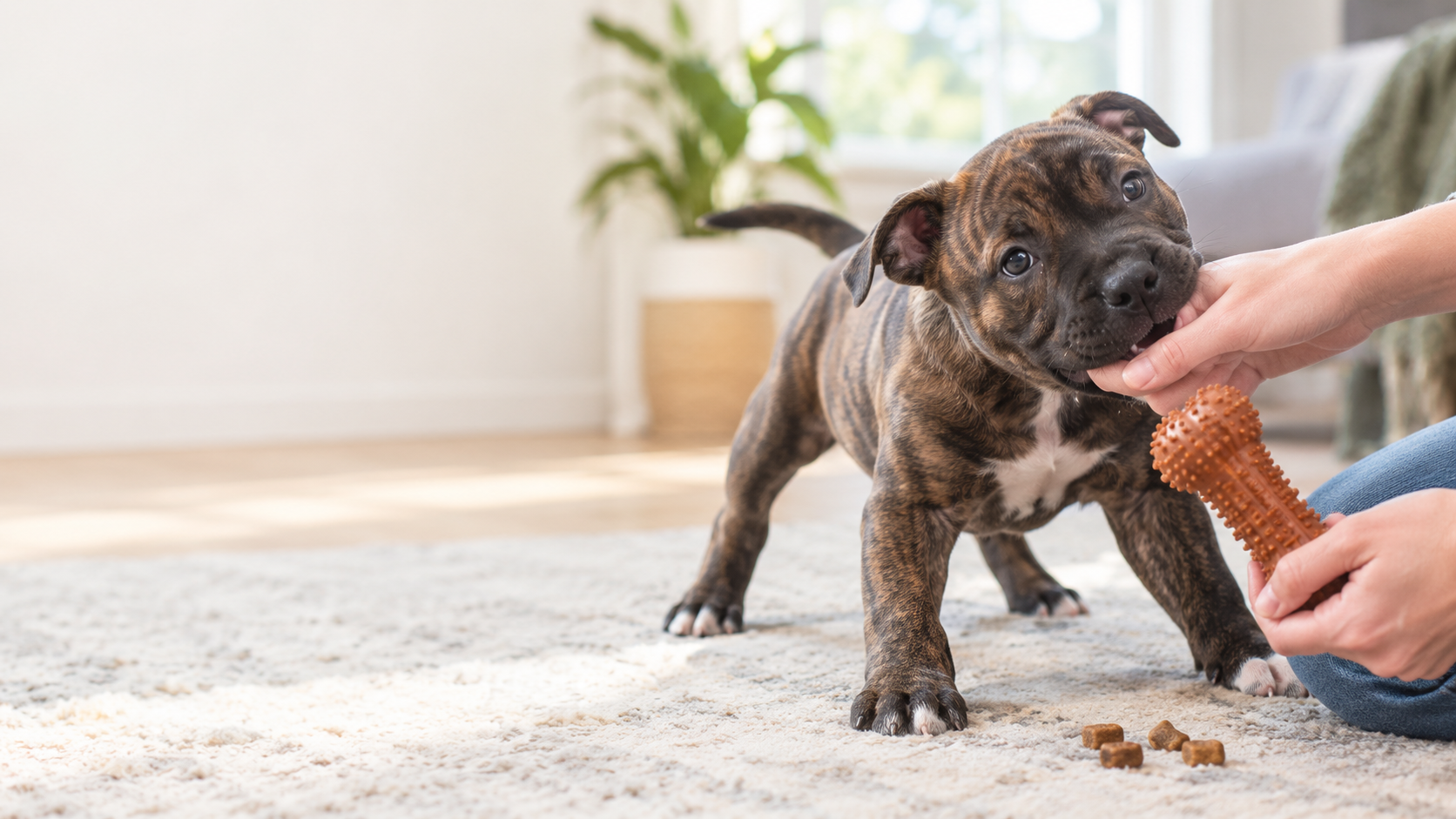
Staffy Puppy Bitting
Staffy Puppy Biting: Why It Happens & How to Teach Bite Inhibition
If your Staffy puppy’s mouth seems to be permanently attached to your hand, sleeve, or ankle right now, you’re not doing anything wrong and your puppy isn’t “aggressive.” Staffies are a famously mouthy breed — they explore, play, and blow off excitement with their mouths — and biting at this age is a normal developmental stage, not a temperament problem. The goal isn’t to stop your puppy from ever using its mouth. It’s to teach bite inhibition: control over how hard that mouth closes.
This guide covers why Staffy puppies bite so much, what bite inhibition actually is, and a step-by-step approach drawn from veterinary and professional trainer sources. I’m not a vet or a certified trainer — this is researched from those sources, not personal expertise, so treat it as a starting point and loop in a trainer or your vet if biting isn’t easing off.
Why Staffy puppies bite so much
A few things stack up in this breed specifically:
What bite inhibition actually is
Bite inhibition is different from “stopping biting altogether.” It’s a dog’s ability to control the pressure of its mouth so that if teeth ever do make contact with skin — during rough play, an accident, a startled reaction — the result is little or no damage.
Puppies learn the basics of this from their littermates: bite a sibling too hard during play, and that sibling yelps and stops playing. The biter learns that hard bites end the fun. Once puppies leave the litter, it’s on us to keep reinforcing that lesson — which is exactly what the training methods below are built around.
This is why trainers and behaviourists treat bite inhibition as a genuine safety skill, not just a manners issue: a dog with well-developed bite inhibition that does eventually bite (fear, pain, a startled moment years down the track) is far less likely to cause serious injury than a dog that never learned to moderate its bite pressure.
Step-by-step: teaching your Staffy puppy bite inhibition
- React like a littermate would — not with force. When your puppy bites too hard, give a sharp, high-pitched “ow!” or yelp, then briefly stop interacting — turn away, stand up, or step back for a few seconds. This mimics exactly what a littermate would do. Avoid yelling, holding the muzzle shut, or any physical correction: sources consistently note this tends to escalate biting (through fear or overstimulation) rather than reduce it.
- Don’t overcorrect — reward the gentle version. The end goal isn’t a puppy that never mouths at all; it’s a puppy that mouths gently. If your puppy is playing with soft pressure, let it continue and praise it. If it escalates, that’s when the yelp-and-pause kicks in. Gradually, over weeks, you tighten the threshold for what counts as “too hard.”
- Redirect to an appropriate chew outlet, every time. The moment teeth touch skin, calmly swap in a chew toy rather than just pulling your hand away (which can read as a fun game of chase to a puppy). This is especially important for a breed this mouthy — a Staffy puppy needs a legitimate outlet for that drive, not just a “no.” A durable teething-stage chew toy is worth having within reach in every room during this phase.
- Manage excitement levels before they spike. If mouthing tends to appear during specific triggers — visitors at the door, high-energy play, evening “zoomies” — pre-empt it. Short structured play sessions, a chew toy on hand before excitement builds, and a calm-down routine (settle on a mat, sniff-based enrichment) all reduce the frequency of bite-y moments rather than just reacting after the fact.
- Be consistent across everyone in the household. Bite inhibition training only works if every person interacting with the puppy uses the same response. If one family member play-wrestles with bare hands while another enforces the yelp-and-pause method, the puppy gets mixed signals and progress stalls.
- Know the realistic timeline. There’s no fixed end date. Some Staffy puppies settle within a few weeks of consistent training; others continue occasional mouthing up to around 9 months, particularly through teething and adolescence. Steady, calm consistency matters more than speed.
When to get outside help
Most puppy biting resolves with consistent handling. It’s worth booking a session with a qualified trainer or talking to your vet if:
A note from Guinness’s household
My own brindle boy Guinness went through the same mouthy phase every Staffy puppy does — it’s about as universal to this breed as the tail-wag.
What made the biggest difference wasn’t any single trick, it was consistency: the same response, every time, from everyone in the house, paired with always having a chew toy within arm’s reach during the teething months.